


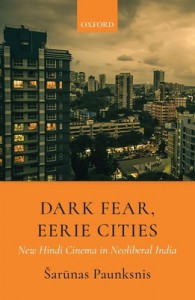
Dark Fear, Eerie Cities
New Hindi Cinema in Neoliberal India


 (0 vote)
Average rating:
| 0 | rating |  = We can do without = We can do without |
| 0 | rating |  = Good book = Good book |
| 0 | rating |  = Excellent book = Excellent book |
| 0 | rating |  = Unique / a reference = Unique / a reference |
Your rating: -
Book Presentation:
Dark Fear, Eerie Cities analyzes a film form that began to emerge in Hindi cinema in early 21st century - a form that is marked by realism, by focusing on urban life and culture of the new middle class, as well as pessimism, violence, fear and the presence of the 'other' in many forms. The author locates new cinematic developments in a much broader context of sociocultural change in contemporary India, and traces the roots of imagining India 'darkly'. The book looks at the new Hindi cinema from different angles and through analysis of crime thrillers and horror films aims to answer some fundamental questions, Why is there so much of pessimism?; What impact does neoliberalism have on the city and cinematic representations?; Why does the darkness, actual and metaphorical, proliferate?; What haunts the city, and why?; Why is the city so dark and eerie?; And what is the relationship between fear and violence on screen and the actual "dark side" of urban life, crime, insecurity one may feel while living in a metropolis, physical insecurity as well as a psychological, one of competition, a desire to succeed and to belong to 'global India'.
About the Author:
Sarunas Paunksnis, Associate Professor, Department of Philosophy, Kaunas University of Technology in Kaunas, Lithuania Sarunas Paunksnis teaches Philosophy at Kaunas University of Technology in Kaunas, Lithuania. His main research areas include but are not limited to Indian cinema, media philosophy, postcolonial theory, globalization and cultural theory. He has recently edited a book titled, Dislocating Globality: Deterritorialization, Difference and Resistance (Brill, 2016).
> From the same author:

The Epistemic Archaeology of Ashish Avikunthak (2025)
Cinema and Religiosity of Everyday Life
Dir. Erin O'Donnell and Šarūnas Paunksnis
Subject: Director > Ashish Avikunthak
> On a related topic:

Bollywood's New Woman (2021)
Liberalization, Liberation, and Contested Bodies
Dir. Megha Anwer and Anupama Arora


The Politics of Hindi Cinema in the New Millennium (2014)
Bollywood and the Anglophone Indian Nation
Muslim Identity in Hindi Cinema (2025)
Poetics and Politics of Genre and Representation


Centring Women in Bollywood Biopics (2024)
Empowerment and Agency in Contemporary Indian Cinema

Postcolonial Bollywood and Muslim Identity (2024)
Production, Representation, and Reception

Bombay Cinema's Islamicate Histories (2022)
by Ira Bhaskar and Richard Allen
 Back
Back

