


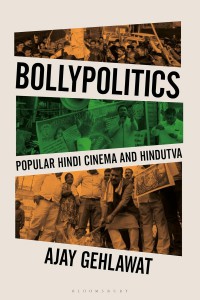
Bollypolitics
Popular Hindi Cinema and Hindutva


 (0 vote)
Average rating:
| 0 | rating |  = We can do without = We can do without |
| 0 | rating |  = Good book = Good book |
| 0 | rating |  = Excellent book = Excellent book |
| 0 | rating |  = Unique / a reference = Unique / a reference |
Your rating: -
Book Presentation:
This book provides an in-depth exploration of the evolving landscape of Bollywood cinema in response to recent socio-political changes in India, including a surge in sectarian violence and the ascent of Hindutva, or Hindu nationalism, under Prime Minister Narendra Modi's leadership.
Through a comprehensive analysis of prominent filmmakers and actors like Sanjay Leela Bhansali, Kangana Ranaut, Akshay Kumar, and Anupam Kher, Ajay Gehlawat investigates the extent to which their recent works align with key tenets of the Hindutva movement. He scrutinizes the growing influence of the Bharatiya Janata Party (BJP) on film production, manifesting in collaborations covering diverse themes, from Modi's Clean India initiative to the nation's space exploration endeavors and grand historical epics such as Padmaavat (2018) and Manikarnika (2019) that seek to reshape Indian history in line with Hindutva ideology.
Gehlawat goes on to dissect smaller budget films like Article 15 (2019) and Shubh Mangal Zyada Saavdhan (2020), which tackle pressing social issues like caste-based violence and homophobia exacerbated by the surge in right-wing extremism in India. In doing so, he elucidates the profound and far-reaching impact of Hindutva ideology on Indian cinematic narratives and aesthetics, while also considering the broader implications for Indian society as a whole.
About the Author:
Lúcia Nagib is Professor of Film and Director of the Centre for Film Aesthetics and Cultures (CFAC) at the University of Reading. Her research has focused, among other subjects, on polycentric approaches to world cinema, new waves and new cinemas, cinematic realism and intermediality. She is the author of World Cinema and the Ethics of Realism (Continuum, 2011), Brazil on Screen: Cinema Novo, New Cinema, Utopia (I.B. Tauris, 2007), The Brazilian Film Revival: Interviews with 90 Filmmakers of the 90s (Editora 34, 2002), Born of the Ashes: The Auteur and the Individual in Oshima's Films (Edusp, 1995), Around the Japanese Nouvelle Vague (Editora da Unicamp, 1993) and Werner Herzog: Film as Reality (EstaçãoLiberdade, 1991). She is the editor of Impure Cinema: Intermedial and Intercultural Approaches to Film (with Anne Jerslev, 2013), Theorizing World Cinema (with Chris Perriam and Rajinder Dudrah, I.B. Tauris, 2011), Realism and the Audiovisual Media (with Cecília Mello, Palgrave, 2009), The New Brazilian Cinema (I.B. Tauris, 2003), Master Mizoguchi (Navegar, 1990) and Ozu (Marco Zero, 1990).Julian Ross is a University Lecturer at the Centre for the Arts in Society.
Press Reviews:
"Bollypolitics is a compelling and contemporary critical reading of key Bollywood films and protagonists in the context of India's political landscape and leadership. As insightful and revealing as the book is about the workings of popular cinema, it is equally telling of the production of culture, representation and identities under particular political maneuvers." ―Rajinder Dudrah, Birmingham City University, UK
"This powerful ethnographic study of the Bollywood milieu is the first major work to capture the intimate ties between the Hindi film industry and the right-wing Hindu regime that now rules India. Through close readings of some crucial promoters and victims of this alignment, Gehlawat's story makes a chilling argument about the capture of an entertainment medium by a larger political regime of icons, images and narratives." ―Arjun Appadurai, NYU, USA
> From the same author:
The Evolution of Song and Dance in Hindi Cinema (2021)
Dir. Ajay Gehlawat and Rajinder Dudrah
Subject: Countries
The Slumdog Phenomenon (2014)
A Critical Anthology
Dir. Ajay Gehlawat
Subject: One Film > Slumdog Millionaire
> On a related topic:
Muslim Identity in Hindi Cinema (2025)
Poetics and Politics of Genre and Representation
Centring Women in Bollywood Biopics (2024)
Empowerment and Agency in Contemporary Indian Cinema
Postcolonial Bollywood and Muslim Identity (2024)
Production, Representation, and Reception
Bombay Cinema's Islamicate Histories (2022)
by Ira Bhaskar and Richard Allen
Beyond Bollywood (2022)
2000 Years of Dance in the Arts of South Asia, Southeast Asia, and the Himalayan Region
Dir. Forrest McGill
Bollywood's New Woman (2021)
Liberalization, Liberation, and Contested Bodies
Dir. Megha Anwer and Anupama Arora
 Back
Back

