


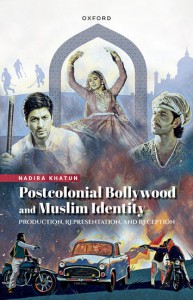
Postcolonial Bollywood and Muslim Identity
Production, Representation, and Reception


 (0 vote)
Moyenne des votes :
| 0 | vote |  = On peut s'en passer = On peut s'en passer |
| 0 | vote |  = Bon livre = Bon livre |
| 0 | vote |  = Excellent livre = Excellent livre |
| 0 | vote |  = Unique / une référence = Unique / une référence |
Votre vote : -
Description de l'ouvrage:
• The book is an important intervention in the discussion around the representation of ethnic and religious minorities in Bollywood cinema.
• It represents the perspectives of consumers as well as producers of Bollywood films by providing insights into the subjective views of various stakeholders such as filmmakers, film critics, and audiences, capturing their constructions of reality via cinematic space.
• It enriches our understanding of the complexities of Muslim representations in India, and the way these intersect with Bollywood.
The book joins a growing scholarship in the field of Bollywood film studies, encompassing methodological sub-groups such as discursive or narrative studies, textual analysis, audience research, and the political economy of Bollywood. It particularly focuses on the representation of Muslims in postcolonial Bollywood cinema that draws upon earlier questions and concerns about narrative style and the politics of representing Muslims. It also includes issues concerning Muslim film genres and the chronological shift in the portrayal of Muslims that is contingent upon national politics. In Bollywood cinema, Muslims have traditionally been portrayed through the lens of religion. Narratives associated with that specific religious identity have been adapted, based on the socio-political setting of the country at the time of the film's making. The study, thus, adds to scholarship on 'representation' in popular Hindi cinema.
À propos de l'auteur :
Dr Nadira Khatun, Assistant Professor, School of Communications, XIM University, Odisha. Nadira Khatun is Assistant Professor at the School of Communications, XIM University, Odisha. She has been a Visiting Assistant Professor at McMaster University, Hamilton. Khatun's research and teaching interests are film studies, cultural studies, postcolonial theory, popular culture, Muslim identity, Indian cinema, media representation, and new media. She has contributed to multiple national and international academic journals and edited volumes on Bollywood, Muslim identity, and social media.
> Sur un thème proche :
Muslim Identity in Hindi Cinema (2025)
Poetics and Politics of Genre and Representation


Bollywood and Globalization (2015)
The Global Power of Popular Hindi Cinema
Dir. David J. Schaefer et Kavita Karan
Bollywood and Globalization (2011)
Indian Popular Cinema, Nation, and Diaspora
Fingerprinting Popular Culture (2007)
The Mythic and the Iconic in Indian Cinema
de Vinay Lal et Ashis Nandy

Ways of Remembering (2024)
Law, Cinema and Collective Memory in the New India
 Retour

