


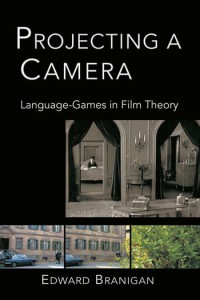
Projecting a Camera
Language-Games in Film Theory


 (0 vote)
Moyenne des votes :
| 0 | vote |  = On peut s'en passer = On peut s'en passer |
| 0 | vote |  = Bon livre = Bon livre |
| 0 | vote |  = Excellent livre = Excellent livre |
| 0 | vote |  = Unique / une référence = Unique / une référence |
Votre vote : -
Description de l'ouvrage:
In Projecting a Camera, film theorist Edward Branigan offers a groundbreaking approach to understanding film theory. Why, for example, does a camera move? What does a camera "know"? (And when does it know it?) What is the camera's relation to the subject during long static shots? What happens when the screen is blank? Through a wide-ranging engagement with Wittgenstein and theorists of film, he offers one of the most fully developed understandings of the ways in which the camera operates in film.
With its thorough grounding in the philosophy of spectatorship and narrative, Projecting a Camera takes the study of film to a new level. With the care and precision that he brought to Narrative Comprehension and Film, Edward Branigan maps the ways in which we must understand the role of the camera, the meaning of the frame, the role of the spectator, and other key components of film-viewing. By analyzing how we think, discuss, and marvel about the films we see, Projecting a Camera, offers insights rich in implications for our understanding of film and film studies.
À propos de l'auteur :
Edward Branigan is Director of Graduate Studies and a Professor of Film Studies at the University of California, Santa Barbara, and is an attorney. He is the author of Point of View in the Cinema and Narrative Comprehension and Film, which was awarded the Katherine Singer Kovacs prize in Cinema Studies.
Revue de Presse:
"Projecting a Camera is not the type of book you can read in a weekend and then put aside. It offers a daunting challenge to our everyday, intuitive understanding of film and theoretical concepts. Its scope, breadth of argument and insights into film theory are simply breathtaking. Like Deleuze’s two cinema books (1986, 1989), it may take the discipline several years to come to terms with Branigan’s innovative perspective, to implement his original insights, and rethink film studies along the lines he proposes."--Warren Buckland, New Review of Film and Television Studies
> Du même auteur :
The Routledge Encyclopedia of Film Theory (2015)
Dir. Edward Branigan et Warren Buckland
Sujet : Theory
> Sur un thème proche :
Radical Embodiment on Film (2026)
Time and the Cinematic Body
Dir. Louis Bayman et Davina Quinlivan
Sujet : Theory
Filmmakers on Film (2026)
Global Perspectives
Dir. André Rui Graça, Manuela Penafria et Eduardo Tulio Baggio
Sujet : Theory
The Attractions of the Moving Image (2025)
Essays on History, Theory, and the Avant-Garde
de Tom Gunning
Sujet : Theory
Contemporary Screen Ethics (2025)
Absences, Identities, Belonging, Looking Anew
Dir. Lucy Bolton, David Martin-Jones et Robert Sinnerbrink
Sujet : Theory
 Retour

