


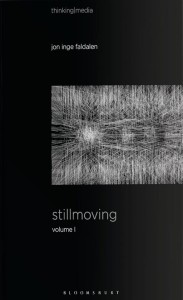
Stillmoving


 (0 vote)
Moyenne des votes :
| 0 | vote |  = On peut s'en passer = On peut s'en passer |
| 0 | vote |  = Bon livre = Bon livre |
| 0 | vote |  = Excellent livre = Excellent livre |
| 0 | vote |  = Unique / une référence = Unique / une référence |
Votre vote : -
Description de l'ouvrage:
This two-volume work explores a static long take, termed a still Einstellung, as well as coexistent still and moving imagery by Lumière, Welles and the MPEG compression codec, to contemplate the kind of image it generates.
Jon Inge Faldalen’s volumes are a theoretical exploration of the concept of Einstellung. The author keeps the original German term, capitalizing on the ambiguity inherent in this type of image phenomenon; in this case, the long take, or at least a continuous unbroken take, effected by an immobile camera whose captured content could potentially contain perceptible movements produced by entities within the composition framed. The author embraces neologisms in order to capture specific aesthetic-technical phenomena more accurately than has hitherto been possible.
Stillmoving I is a film theoretical exploration of the concept of Einstellung. The author asks whether this image is a still image, or a moving image, or both, or neither, or, finally, what Faldalen terms stillmoving. Underlying these deliberations is the question of how cinema represents or mediates stillness. It unfolds over three chapters that examine the concept of still Einstellung in relation to slow cinema scholarship throughout the last two decades, in relation to approaches referred to as stillmoving scholarship, and in relation to reflections and shadows.
Stillmoving II continues the work of the first volume, exploring the concept of Einstellung through a small set of specific case studies, including Louis Lumière’s Quai de l’Archevêché (Lumière operator, 1896), André Bazin’s analysis of the kitchen scene in The Magnificent Ambersons (Orson Welles, 1942), and James Benning’s Stemple Pass (2012), as well as what the author calls “digital imagenesis,” which concerns the MPEG compression codec.
À propos de l'auteur :
Jon Inge Faldalen is Associate Professor of Media and Screen Studies at the University of Oslo, Norway. He is the founder of the multi-million kroner research and teaching initiative Screen Cultures (2019-2023) at the University of Oslo. His research is primarily in the disciplines of 'screen studies' and 'cinema and media studies', and he frequently writes and talks about films and TV series. He has written close to five hundred critical reviews, essays and interviews, and has since 2003 interviewed hundreds of filmmakers, including the late Theo Angelopoulos and Abbas Kiarostami, Roy Andersson, Judd Apatow, Miranda July, Hirokazu Koreeda, David Lynch, Jafar Panahi, Ulrich Seidl, Abderrahmane Sissako, Joachim Trier, Liv Ullmann, Apichatpong Weerasethakul and Ruben Östlund.
> Sur un thème proche :


Taking Place (2011)
Location and the Moving Image
Dir. John David Rhodes et Elena Gorfinkel
Sujet : Theory
 Retour

