


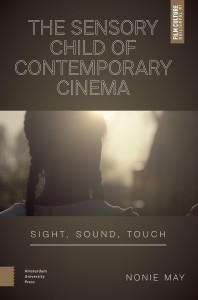
The Sensory Child of Contemporary Cinema
Sight, Sound, Touch
by Nonie May


 (0 vote)
Average rating:
| 0 | rating |  = We can do without = We can do without |
| 0 | rating |  = Good book = Good book |
| 0 | rating |  = Excellent book = Excellent book |
| 0 | rating |  = Unique / a reference = Unique / a reference |
Your rating: -
Book Presentation:
The Sensory Child: Sight, Sound, Touch examines a poetic film form evident in contemporary cinema that seems intent on capturing the textures, the materials, and the sensations of childhood. These films foreground the child’s point of view, construct a child’s gaze, and mobilise an aesthetic that evokes a sensory recollection of childhood. This complex arrangement of aesthetic modes is intended to address the adult spectator bodily, and evoke the vivid, sensory memories of childhood. The Sensory Child rethinks a gap in contemporary film theory created by a seeming hiatus between psychoanalytic and phenomenological approaches to the cinema. The book examines key instances of this aesthetic of childhood in the films Aftersun (2022), The Fits (2015), What Maisie Knew (2013), and Moonlight (2016). May argues that psychoanalytic theory can elucidate the significance of such tactile moments, offering insight into the meaning evoked for the spectator by this sensory, poetic film form.
About the Author:
Nonie May is a Lecturer at The University of Melbourne, Australia. Her research mobilises feminist approaches to psychoanalytic film theory. Recent publications include the Barbie Dossier, Feminist Media Studies, (2024), the chapter ‘Written on the Body’, The UnDead Child (2024), and the prize-winning essay An Cailín Ciúin’, Senses of Cinema (2022).
> On a related topic:
Screens and Illusionism (2024)
Alternative Teleologies of Mediation
Dir. Peter Bloom and Dominique Jullien
Subject: Theory
The Prison of Time (2024)
Stanley Kubrick, Adrian Lyne, Michael Bay and Quentin Tarantino
Subject: Theory
Deep Mediations (2021)
Thinking Space in Cinema and Digital Cultures
Dir. Karen Redrobe and Jeff Scheible
Subject: Theory
 Back
Back

