


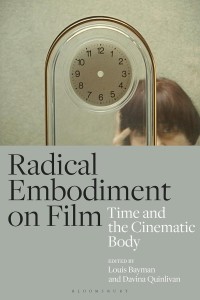
Radical Embodiment on Film
Time and the Cinematic Body
Edited by Louis Bayman and Davina Quinlivan


 (0 vote)
Average rating:
| 0 | rating |  = We can do without = We can do without |
| 0 | rating |  = Good book = Good book |
| 0 | rating |  = Excellent book = Excellent book |
| 0 | rating |  = Unique / a reference = Unique / a reference |
Your rating: -
Book Presentation:
This innovative volume demonstrates the embodiment of time to be a vital part of the aesthetic experience of cinema. Analysing a broad range of films including Beasts of the Southern Wild (USA, 2012), Talk to Her (Spain, 2002), Millennium Actress (Japan, 2001), Jab Tak Hai Jaan (India, 2012), and Jinpa (China, 2018), contributors examine key questions of embodied time as represented on screen. They explore how cinematic time can be a way of rethinking the centrality of the individual, of depicting gendered differences, of decentring western perspectives to represent a widened global context, and of expanding what embodiment means in post-human narratives. The volume not only highlights specific discourses of radical, lived experience in film, but also considers how distinctions of race and class, gender and sexuality, migration, religion, and indigeneity affect these depictions of embodied subjectivity.
Contributors:
Emma Ben Ayoun, Louis Bayman, Andrés Buesa, Mariana Cunha, MaoHui Deng, Felipe Espinoza Garrido, Victor Fan, Sahika Erkonan, Joseph Jenner, Nick Jones, Kayla Meyers, Salma Monani, Davina Quinlivan, Francesca Sobande and Pinar Yildiz
About the authors:
Louis Bayman is Associate Professor of Film Studies at the University of Southampton, UK. He is author of The Operatic and the Everyday in Postwar Italian Film Melodrama (2014) and co-editor of Folk Horror on Film: Return of the British Repressed (2023).Davina Quinlivan is a researcher, writer and curator, currently teaching at the University of Exeter, UK. She is author of Shalimar: A Story of Place and Migration (2022) and Filming the Body in Crisis: Trauma, Healing and Hopefulness (2015).
Press Reviews:
"In this diverse and thoughtfully curated collection, Bayman and Quinlivan have brought together a set of original and provocative chapters that delve deeply into how time is imbricated into our experience of cinema. Challenging the reader to examine what we may take for granted, Radical Embodiment demonstrates how the concept of embodied time is a way to focus on film's political, environmental, and philosophical possibilities. A genuinely valuable evolution of film thinking on time and the body." ―Lucy Bolton, Professor of Film Philosophy, Queen Mary University of London, UK
> From the same authors:


Directory of World Cinema / Brazil (2014)
Dir. Natália Pinazza and Louis Bayman

World Film Locations / São Paulo (2013)
Dir. Natália Pinazza and Louis Bayman

> On a related topic:
The Prison of Time (2024)
Stanley Kubrick, Adrian Lyne, Michael Bay and Quentin Tarantino
Subject: Theory
Time, Existential Presence and the Cinematic Image (2018)
Ethics and Emergence to Being in Film
Subject: Theory
Temporality in American Filmic Autobiography (2018)
Cinema, Automediality and Grammatology with 'film Portrait' and 'joyce at 34'
Subject: Theory


Making Sense of Cinema (2017)
Empirical Studies into Film Spectators and Spectatorship
Dir. Carrielynn D. Reinhard and Christopher J. Olson
Subject: Theory
 Back
Back