


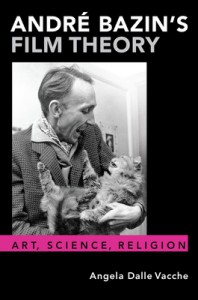
André Bazin's Film Theory
Art, Science, Religion


 (0 vote)
Average rating:
| 0 | rating |  = We can do without = We can do without |
| 0 | rating |  = Good book = Good book |
| 0 | rating |  = Excellent book = Excellent book |
| 0 | rating |  = Unique / a reference = Unique / a reference |
Your rating: -
Book Presentation:
Through metaphors and allusions to art, science, and religion, André Bazin's writings on the cinema explore a simple yet profound question: what is a human? For the famous French film critic, a human is simultaneously a rational animal and an irrational being. Bazin's idea of the cinema is a mind-machine where the ethical implications have priority over aesthetic issues. And in its ability to function as an art form for the masses, cinema is the only medium that can address an audience at the individual and community levels simultaneously-- the audience sees the same film, but each individual relates to the narrative in a different way. In principle, cinema can unsettle our routines in productive ways and expand our sense of belonging to a much larger picture.
By arguing that this dissident Catholic's worldview is anti-anthropocentric, Angela Dalle Vacche concludes that André Bazin's idea of the cinema recapitulates the histories of biological evolution and modern technology inside our consciousness. Through the projection of recorded traces of the world onto a brain-like screen, the cinema can open viewers up to self-interrogation and empathy towards Otherness. Bazin was neither a spiritualist nor an animist or a pantheist, yet his film theory leads also to ideas of a more cosmological persuasion: through editing and camera movement, cinema explores our belonging to a vast universe that extends from the microbes of the microscope to the stars of the telescope. Such ideas of connectedness, coupled with Bazin's well-known emphasis of realism, form the foundation for his film theory's embrace of Italian neorealism. Choosing to avoid a quantitative naturalism based on accumulation of details, Bazin's theory instead promotes the kind of cinema that celebrates perceptual displacement, the objectification of human behavior, and one's own critical self-awareness.
About the Author:
Angela Dalle Vacche is Professor of Cinema Studies at the Georgia Institute of Technology in Atlanta. She has written extensively on the representation of history in film; on Italian women and early cinema; on intermediality and color. She is the author or editor of such works as Film, Art, New Media: Museum without Walls? (2012) and Diva: Defiance and Passion in Early Cinema (2008), and is currently developing a book on African cinema.
Press Reviews:
"Dalle Vacche's laudable scholarly efforts reveal Bazin as a deeply committed and especially perceptive and subtle critic, whose importance must not be overlooked." -- Marc Furstenau, Canadian Journal of Film Studies
"Breathing Bazin--taking in all his writings--Angela Dalle Vacche now exhales his singular, commodious spirit. Seizing on the ingenious metaphors that crystallize his vast knowledge of the arts, sciences and theology, she demonstrates through uncommon examples how, for this 'tragic optimist,' the camera's cold stare, its 'anti-anthropocentrism'; can produce a profound and touching humanism, fostering an ethical rapport with the earth and all its creatures that we need today more than ever." -- Dudley Andrew , Yale University
> From the same author:
The Body in the Mirror (2016)
Shapes of History in Italian Cinema

Color, The Film Reader (2006)
Dir. Angela Dalle Vacche and Brian Price
Subject: Technique > Aesthetics
> On a related topic:
Opening Bazin (2011)
Postwar Film Theory and Its Afterlife
Dir. Dudley Andrew and Herve Joubert-Laurencin
Subject: Theory

Radical Embodiment on Film (2026)
Time and the Cinematic Body
Dir. Louis Bayman and Davina Quinlivan
Subject: Theory
 Back
Back

