


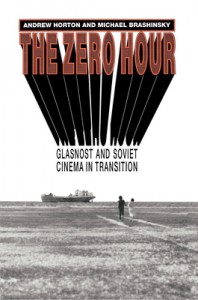
The Zero Hour
Glasnost and Soviet Cinema in Transition
by Andrew Horton and Michael Brashinsky


 (0 vote)
Average rating:
| 0 | rating |  = We can do without = We can do without |
| 0 | rating |  = Good book = Good book |
| 0 | rating |  = Excellent book = Excellent book |
| 0 | rating |  = Unique / a reference = Unique / a reference |
Your rating: -
Book Presentation:
Now faced with the "zero hour" created by a new freedom of expression and the dramatic breakup of the Soviet Union, Soviet cinema has recently become one of the most interesting in the world, aesthetically as well as politically. How have Soviet filmmakers responded to the challenges of glasnost? To answer this question, the American film scholar Andrew Horton and the Soviet critic Michael Brashinsky offer the first book-length study of the rapid changes in Soviet cinema that have been taking place since 1985. What emerges from their collaborative dialogue is not only a valuable work of film criticism but also a fascinating study of contemporary Soviet culture in general. Horton and Brashinsky examine a wide variety of films from BOMZH (initials standing for homeless drifter) through Taxi Blues and the glasnost blockbuster Little Vera to the Latvian documentary Is It Easy to Be Young? and the "new wave" productions of the "Wild Kazakh boys." The authors argue that the medium that once served the Party became a major catalyst for the deconstruction of socialism, especially through documentary filmmaking. Special attention is paid to how filmmakers from 1985 through 1990 represent the newly "discovered" past of the pre-glasnost era and how they depict troubled youth and conflicts over the role of women in society. The book also emphasizes the evolving uses of comedy and satire and the incorporation of "genre film" techniques into a new popular cinema. An intriguing discussion of films of Georgia, Estonia, Latvia, Lithuania, and Kazakhstan ends the work.
> From the same authors:

Play It Again, Sam (2022)
Retakes on Remakes
Dir. Andrew Horton and Stuart Y. McDougal
Subject: Economics

Screenwriting for a Global Market (2004)
Selling Your Scripts from Hollywood to Hong Kong
Subject: Technique > Scriptwriting
Writing the Character-Centered Screenplay (2000)
Updated and Expanded edition
Subject: Technique > Scriptwriting
Three More Screenplays by Preston Sturges (1998)
The Power and the Glory, Easy Living, and Remember the Night
by Preston Sturges and Andrew Horton
Subject: One Film > Remember the Night, The Power and the Glory, Easy Living
Russian Critics on the Cinema of Glasnost (1994)
Dir. Michael Brashinsky, Andrew Horton and William Rothman
Subject: Countries > Russia / USSR
> On a related topic:
Designing Russian Cinema (2024)
The Production Artist and the Material Environment in Silent Era Film
by Eleanor Rees
Subject: Countries > Russia / USSR
Ruptures and Continuities in Soviet/Russian Cinema (2019)
Styles, characters and genres before and after the collapse of the USSR
Dir. Birgit Beumers and Eugenie Zvonkine
Subject: Countries > Russia / USSR
Historical Dictionary of Russian and Soviet Cinema (2016)
Subject: Countries > Russia / USSR
Cinepaternity (2010)
Fathers and Sons in Soviet and Post-Soviet Film
Dir. Helena Goscilo and Yana Hashamova
Subject: Countries > Russia / USSR
The Cinema of Russia and the Former Soviet Union (2007)
Dir. Birgit Beumers
Subject: Countries > Russia / USSR
Revolt of the Filmmakers (2000)
The Struggle for Artistic Autonomy and the Fall of the Soviet Film Industry
Subject: Countries > Russia / USSR
Inside the Film Factory (1994)
New Approaches to Russian and Soviet Cinema
Dir. Richard Taylor and Ian Christie
Subject: Countries > Russia / USSR
 Back
Back

