


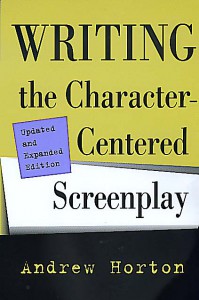
Writing the Character-Centered Screenplay
Updated and Expanded edition


 (0 vote)
Average rating:
| 0 | rating |  = We can do without = We can do without |
| 0 | rating |  = Good book = Good book |
| 0 | rating |  = Excellent book = Excellent book |
| 0 | rating |  = Unique / a reference = Unique / a reference |
Your rating: -
Book Presentation:
"We need good screenwriters who understand character." Everywhere Andrew Horton traveled in researching this book—from Hollywood to Hungary—he heard the same refrain. Yet most of the standard how-to books on screenwriting follow the film industry's earlier lead in focusing almost exclusively on plot and formulaic structures.
With this book, Horton, a film scholar and successful screenwriter, provides the definitive work on the character-based screenplay. Exceptionally wide-ranging—covering American, international, mainstream, and "off-Hollywood" films, as well as television—the book offers creative strategies and essential practical information.
Horton begins by placing screenwriting in the context of the storytelling tradition, arguing through literary and cultural analysis that all great stories revolve around a strong central character. He then suggests specific techniques and concepts to help any writer—whether new or experienced—build more vivid characters and screenplays. Centering his discussion around four film examples—including Thelma & Louise and The Silence of the Lambs—and the television series, Northern Exposure, he takes the reader step-by-step through the screenwriting process, starting with the development of multi-dimensional characters and continuing through to rewrite. Finally, he includes a wealth of information about contests, fellowships, and film festivals.
Espousing a new, character-based approach to screenwriting, this engaging, insightful work will prove an essential guide to all of those involved in the writing and development of film scripts.
Press Reviews:
"I have been searching for a book such as Horton's for years—and finally it has arrived. Horton's penetrating analysis and graceful writing style open up the key topic of characterization as no other book has. . . . I recommend it highly."—Paul Lucey, University of Southern California
> From the same author:

Play It Again, Sam (2022)
Retakes on Remakes
Dir. Andrew Horton and Stuart Y. McDougal
Subject: Economics

Screenwriting for a Global Market (2004)
Selling Your Scripts from Hollywood to Hong Kong
Subject: Technique > Scriptwriting
Three More Screenplays by Preston Sturges (1998)
The Power and the Glory, Easy Living, and Remember the Night
by Preston Sturges and Andrew Horton
Subject: One Film > Remember the Night, The Power and the Glory, Easy Living
Russian Critics on the Cinema of Glasnost (1994)
Dir. Michael Brashinsky, Andrew Horton and William Rothman
Subject: Countries > Russia / USSR

The Zero Hour (1992)
Glasnost and Soviet Cinema in Transition
by Andrew Horton and Michael Brashinsky
Subject: Countries > Russia / USSR
> On a related topic:
Character is Structure (2023)
The Insider's Guide to Screenwriting
by Ted Wilkes and Phil Hughes
Subject: Technique > Scriptwriting
The Defining Moment (2022)
How Writers and Actors Build Characters
by Christopher Riley and Kathy Riley
Subject: Technique > Scriptwriting
Character (2021)
The Art of Role and Cast Design for Page, Stage, and Screen
by Robert McKee
Subject: Technique > Scriptwriting
The Heart of Your Script (2026)
The Insider's Guide to Writing the Difficult Middle Section of a Screenplay
by Ted Wilkes and Phil Hughes
Subject: Technique > Scriptwriting
Games Directors Play (2026)
Tricks and Stratagems of Cinematic Storytelling
Subject: Technique > Scriptwriting
Integrated Storytelling by Design (2026)
Concepts, Principles and Methods for New Narrative Dimensions
Subject: Technique > Scriptwriting
Rem Koolhaas as Scriptwriter (2025)
OMA Architecture Script for West Berlin
Subject: Technique > Scriptwriting

Crafting Short Screenplays That Connect (2025)
Subject: Technique > Scriptwriting
 Back
Back

