


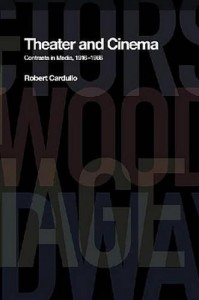
Theater and Cinema
Contrasts in Media,1916 - 1966


 (0 vote)
Average rating:
| 0 | rating |  = We can do without = We can do without |
| 0 | rating |  = Good book = Good book |
| 0 | rating |  = Excellent book = Excellent book |
| 0 | rating |  = Unique / a reference = Unique / a reference |
Your rating: -
Book Presentation:
By focusing on the important early theoretical writings about these two media, Theater and Cinema: Contrasts in Media, 1916-1966 becomes one of the first books in over thirty-five years to examine the historical, cultural, and aesthetic relationships between theater and film. As we move through the twenty-first century, almost all artists, students, and critics working in theater will have had earlier and greater exposure to film than to theater. In fact, film has become central to the way in which we perceive and formulate stories, images, ideas, and sounds. At the same time, film, video, and digital media occupy an increasingly significant place in theater study, both for the adaptation of plays and for the documentation or preservation of theatrical performances. Yet far too often young theater and film artists, as well as educators, make the jump from one medium to the other without being fully aware of the ways in which the qualities of each medium affect content and artistic expression. This book is intended to fill such a gap by providing a theoretical and practical foundation for understanding the effect that film and drama have had, and continue to have, on each other s development. The theoretical as well as practical foundation provided by the writings in this volume, furthermore, is the one established during the fifty years from 1916 to 1966, when, despite the advent of the feature-length film, the introduction of sound, and the triumph of color, the theater was still seen as a serious artistic rival to the cinema. The introduction to Theater and Cinema provides a history of the relationship between theater and film, starting with the pre-cinematic, late nineteenth-century impulse towards capturing spectacular action on the stage and examining the artistic and commercial interaction between film and drama, both in popular and experimental work, throughout the twentieth century. By attempting to trace the cross-fertilization between theater and film connecting the business practices of the evolving Hollywood system, for example, to the types of artistic appropriation in which Broadway has long engaged the introduction provides an historical context for the essays to come, while arguing for the vital importance of an understanding of both theater and film to the contemporary practice of either.
Academica Press is an independent scholarly press specializing in publishing monographs and reference material in the humanities and social sciences. We are particularly interested in producing works of scholarly interest English language studies, literary history and criticism ,drama, sociology, education and Irish studies. (Our dedicated imprint, Maunsel & Co., specializes in scholarly research in Irish studies.) We have recently developed projects in African and Afro-American research areas as well as Theology and Legal Studies.
Some select areas where we publish include:
-American 19th- and 20th-Century Language and Literature
-British 19th- and 20th-Century Language and Literature
-Irish Studies
-African Studies and African-American Studies
-Law, including Sports Law
-Higher Education
-English Church History
About the Author:
Robert Cardullo is Professor of Media and Communication at the Izmir University of Economics in Izmir, Turkey, where he teaches courses in film history, theory, and criticism as well as popular culture. He was formerly on the faculty of the University of Michigan. The author of over 250 articles, notes, and reviews, he is also the author, editor, or translator of more than thirty books, among them A Critical Edition of Two Modern Plays on the Dramatic Character of Sir John Falstaff; Theater of the Avant-Garde, 1890-1950: A Critical Anthology; The Theater of Fernand Crommelynck: Eight Plays; and German-Language Comedy: A Critical Anthology,Antigone Adapted (2011)
> From the same author:

Nuri Bilge Ceylan (2015)
Essays and Interviews
Dir. Robert Cardullo
Subject: Director > Nuri Bilge Ceylan
> On a related topic:
Radical Embodiment on Film (2026)
Time and the Cinematic Body
Dir. Louis Bayman and Davina Quinlivan
Subject: Theory
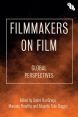
Filmmakers on Film (2026)
Global Perspectives
Dir. André Rui Graça, Manuela Penafria and Eduardo Tulio Baggio
Subject: Theory
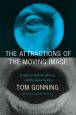
The Attractions of the Moving Image (2025)
Essays on History, Theory, and the Avant-Garde
by Tom Gunning
Subject: Theory
Contemporary Screen Ethics (2025)
Absences, Identities, Belonging, Looking Anew
Dir. Lucy Bolton, David Martin-Jones and Robert Sinnerbrink
Subject: Theory
Cinecepts, Deleuze, and Godard-Miéville (2025)
Developing Philosophy through Audiovisual Media
Subject: Theory
 Back
Back

