


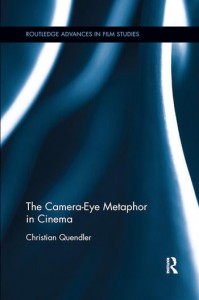
The Camera-Eye Metaphor in Cinema


 (0 vote)
Average rating:
| 0 | rating |  = We can do without = We can do without |
| 0 | rating |  = Good book = Good book |
| 0 | rating |  = Excellent book = Excellent book |
| 0 | rating |  = Unique / a reference = Unique / a reference |
Your rating: -
Book Presentation:
This book explores the cultural, intellectual, and artistic fascination with camera-eye metaphors in film culture of the twentieth century. By studying the very metaphor that cinema lives by, it provides a rich and insightful map of our understanding of cinema and film styles and shows how cinema shapes our understanding of the arts and media. As current new media technologies are attempting to shift the identity of cinema and moving imagery, it is hard to overstate the importance of this metaphor for our understanding of the modalities of vision. In what guises does the "camera eye" continue to survive in media that is called new?
About the Author:
Christian Quendler is Associate Professor in the Department of American Studies at the University of Innsbruck, Austria. He is the author of From Romantic Irony to Postmodernist Metafiction and Interfaces of Fiction.
Press Reviews:
"The metaphor of camera as eye is fundamental to both everyday discussion as well as more academic theories of cinema: it is a pervasive metaphor through which we understand cinema on several levels. Christian Quendler’s detailed study of the camera-eye metaphor is therefore a significant and erudite contribution to scholarship. But, more than this, Quendler’s study takes a truly interdisciplinary approach to this metaphor. The Camera-Eye Metaphor in Cinema is not dogmatic in limiting itself to one or two theoretical positions; far from it. This book encompasses a broad array of theoretical approaches – from the philosophy of mind to art theory, narratology, and gender studies. It therefore has a potentially wide appeal, not only in film studies, but also cultural and media studies more generally." – Warren Buckland, Oxford Brookes University, UK
See the publisher website: Routledge
> From the same author:
Global Mountain Cinema (2025)
Dir. Kamaal Haque, Christian Quendler and Caroline Schaumann
Subject: General
> On a related topic:
Radical Embodiment on Film (2026)
Time and the Cinematic Body
Dir. Louis Bayman and Davina Quinlivan
Subject: Theory
Filmmakers on Film (2026)
Global Perspectives
Dir. André Rui Graça, Manuela Penafria and Eduardo Tulio Baggio
Subject: Theory
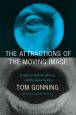
The Attractions of the Moving Image (2025)
Essays on History, Theory, and the Avant-Garde
by Tom Gunning
Subject: Theory
Contemporary Screen Ethics (2025)
Absences, Identities, Belonging, Looking Anew
Dir. Lucy Bolton, David Martin-Jones and Robert Sinnerbrink
Subject: Theory
Cinecepts, Deleuze, and Godard-Miéville (2025)
Developing Philosophy through Audiovisual Media
Subject: Theory
 Back
Back

