


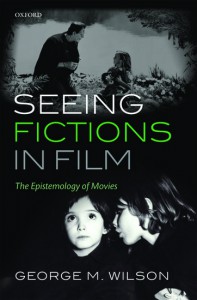
Seeing Fictions in Film
The Epistemology of Movies


 (0 vote)
Moyenne des votes :
| 0 | vote |  = On peut s'en passer = On peut s'en passer |
| 0 | vote |  = Bon livre = Bon livre |
| 0 | vote |  = Excellent livre = Excellent livre |
| 0 | vote |  = Unique / une référence = Unique / une référence |
Votre vote : -
Description de l'ouvrage:
• Ground-breaking study of how film works
• Eagerly awaited book from one of the leading figures in film studies
• Features close readings of classic and contemporary films
• Written equally for readers in film studies and in philosophy
In works of literary fiction, it is a part of the fiction that the words of the text are being recounted by some work-internal 'voice': the literary narrator. One can ask similarly whether the story in movies is told in sights and sounds by a work-internal subjectivity that orchestrates them: a cinematic narrator. George M. Wilson argues that movies do involve a fictional recounting (an audio-visual narration) in terms of the movie's sound and image track. Viewers are usually prompted to imagine seeing the items and events in the movie's fictional world and to imagine hearing the associated fictional sounds. However, it is much less clear that the cinematic narration must be imagined as the product of some kind of 'narrator' - of a work-internal agent of the narration. Wilson goes on to examine the further question whether viewers imagine seeing the fictional world face-to-face or whether they imagine seeing it through some kind of work-internal mediation. It is a key contention of this book that only the second of these alternatives allows one to give a coherent account of what we do and do not imagine about what we are seeing on the screen. Having provided a partial account of the foundations of film narration, the final chapters explore the ways in which certain complex strategies of cinematic narration are executed in three exemplary films: David Fincher's Fight Club, von Sternberg's The Scarlet Empress, and the Coen brothers' The Man Who Wasn't There.
À propos de l'auteur :
George M. Wilson, University of Southern California George M. Wilson was born and raised in Oregon. He received his AB from the University of Kansas and his PhD from Cornell. He has taught at Johns Hopkins University, the University of California at Davis, and he is currently a professor of philosophy and cinematic arts at the University of Southern California. He has visited at Harvard and Princeton and was a Fellow at the National Humanities Center. Besides film aesthetics, he has worked and published in the fields of philosophy of language, the theory of action, and on the philosophy of Wittgenstein.
Revue de Presse:
"Seeing Fiction in Film is among the most rewarding works on film and film narrative that are currently on offer. Though intricately argued, it is surprisingly easy to follow. Though extremely sophisticated, it keeps one thoroughly engaged. If, like me, one has not followed the ins and outs of the debate on the perception and cognition of cinematic fiction, after reading this work, one will be well prepared to pursue it further. If one has followed it, this work is essential reading for moving on to the next phase of the debate." - Robert Stecker, Mind
"... the strength of the book is how it uses the concept of imagined seeing to develop an account of cinematic narration, which in turn informs the aesthetic interpretation of film The book thus has much to recommend it to anyone interested in issues at the intersection of epistemology and aesthetics." - Analysis
> Du même auteur :
> Sur un thème proche :
Contemporary Screen Ethics (2025)
Absences, Identities, Belonging, Looking Anew
Dir. Lucy Bolton, David Martin-Jones et Robert Sinnerbrink
Sujet : Theory
Cinecepts, Deleuze, and Godard-Miéville (2025)
Developing Philosophy through Audiovisual Media
Sujet : Theory
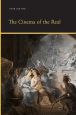
Cinema of/for the Anthropocene (2025)
Affect, Ecology, and More-Than-Human Kinship
Dir. Katarzyna Paszkiewicz et Andrea Ruthven
Sujet : Theory
 Retour

