

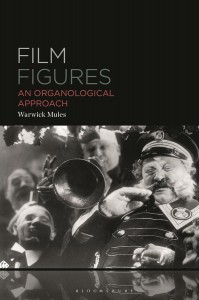
Film Figures
An Organological Approach


 (0 vote)
Average rating:
| 0 | rating |  = We can do without = We can do without |
| 0 | rating |  = Good book = Good book |
| 0 | rating |  = Excellent book = Excellent book |
| 0 | rating |  = Unique / a reference = Unique / a reference |
Your rating: -
Book Presentation:
Film Figures develops a figural account of the memory structure of films.
Employing theoretical concepts drawn from a range of sources, including French post-humanist philosophy and German Idealism, the book undertakes an organology of film guided by the work of Bernard Stiegler whose philosophy of mnemotechnesis provides the framework of analysis. Situating films in the quantum field of spacetime relativity as a field of cosmic views, inquiry into film figures begins with disturbances in the experience of films themselves, posing questions of the relation between the dead past and the living future in film story-telling. By breaking the façade of the continuing present through self-questioning, we open films to their figural dimensions in the counter-movement of drive as negentropic resistance. Following the back-movement of drive switches our perception to the figural register in which characters become figures probing blindly for what the film will have been in another time – a time yet to be lived. By following the anterior possibilities of this other time, we open films to the archival future in which a new future comes forth.
This book provides theoretical and analytical concepts as well as strategies for taking a step into this future, guided by questions of the right path to take given the relativity of views in which the film can be experienced. Films analysed include Murnau's The Last Laugh, Capra's It's a Wonderful Life, Hitchcock's Rear Window, Welles's The Lady from Shanghai, Fellini's Intervista, Antonioni's L'Eclisse, Bresson's Une Femme Douce, and Zeller's The Father.
About the Author:
Warwick Mules is Adjunct Associate Professor at Southern Cross University, Australia. He is the author of With Nature: Nature Philosophy as Poetics through Schelling, Heidegger, Benjamin and Nancy (2014) and publishes in the philosophy of film and visual technology.
Press Reviews:
"Warwick Mules' Film Figures advances a bold thesis: that, in its multi-layered depictions of people, stories and worlds, cinema is always feeling its way toward a future, imagining other outcomes, contesting the world's collective death-impulse. Exploring, in a new and original manner, a range of cinematic examples from Alfred Hitchcock and Orson Welles to Robert Bresson and Michelangelo Antonioni, Mules offers us not only an inspiring method of film analysis, but also an urgent rallying cry for planetary consciousness and renewal." ―Adrian Martin, Monash University, Australia, and author of Mysteries of Cinema (2018)
"Warwick Mules engages in a serious and ambitious attempt to ask what is really going on when we watch a movie, via the work of several philosophers but above all Bernard Stiegler. The highly original "figural" approach pursued by Mules sees films as ways in which we feel our way towards the future, where doing so, in the incompletion if not the failure to cohere of the individual, the collective and the film itself, comes to be seen as the very thing that opens pathways towards telling a future otherwise. The spiralling backwards and forwards movements and leaps of time described by Mules are exemplified in brilliant readings of a diverse range of movies – from Rear Window, The Third Man and L'Eclisse to Beckett's Film, but especially the more recent The Father (by Florian Zeller) – leaving the reader with the feeling that, just perhaps, cinema has not yet exhausted its potential to reorient the disorientation that characterizes our contemporary inexistence." ―Daniel Ross, Independent Scholar, Australia
> On a related topic:
Contemporary Screen Ethics (2025)
Absences, Identities, Belonging, Looking Anew
Dir. Lucy Bolton, David Martin-Jones and Robert Sinnerbrink
Subject: Theory
Cinecepts, Deleuze, and Godard-Miéville (2025)
Developing Philosophy through Audiovisual Media
Subject: Theory
Cinema of/for the Anthropocene (2025)
Affect, Ecology, and More-Than-Human Kinship
Dir. Katarzyna Paszkiewicz and Andrea Ruthven
Subject: Theory
 Back
Back

