


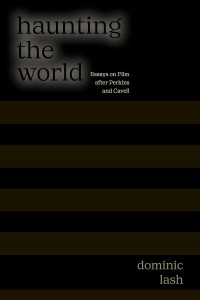
Haunting the World
Essays on Film After Perkins and Cavell
by Dominic Lash


 (0 vote)
Average rating:
| 0 | rating |  = We can do without = We can do without |
| 0 | rating |  = Good book = Good book |
| 0 | rating |  = Excellent book = Excellent book |
| 0 | rating |  = Unique / a reference = Unique / a reference |
Your rating: -
Book Presentation:
Argues that the experience of the ordinary film viewer and the investigations of the film scholar or film philosopher are not necessarily so far apart.
In Haunting the World, Dominic Lash tries to show that taking films seriously in no way interferes with the pleasure we get from watching them. The book draws its title from the philosopher Stanley Cavell, who saw "haunting the world" as something we are all prone to and who claimed that cinema's relationship with this tendency is both an "importance" and a "danger" of film. Specifically, Lash proposes that the work of Cavell and of the critic and scholar V. F. Perkins have valuable lessons to offer contemporary film studies, some of which are in danger of being neglected. Written in a lively and approachable style that makes philosophical ideas accessible without simplifying them, the book argues that film theory risks going awry when it dismisses or underestimates the experience of the ordinary film viewer. Haunting the World offers fresh accounts of fundamental topics, including description, experience, and agency, and examines in detail important films by Ildikó Enyedi, Paul Thomas Anderson, Ridley Scott, Werner Herzog, Andrei Tarkovsky, Kelly Reichardt, and more.
About the Author:
Dominic Lash is the author of several books, including The Cinema of Disorientation: Inviting Confusions and Robert Pippin and Film: Politics, Ethics, and Psychology after Modernism, and the coeditor, with Hoi Lun Law, of Gilles Deleuze and Film Criticism: Philosophy, Theory, and the Individual Film.
Press Reviews:
"A vital, generous, and illuminating contribution not only to writing about Perkins and Cavell but to the further flourishing of accessible writing about film and its achievements. Dominic Lash has written a series of essays that offer each in its own marvelous way a fresh path for thinking about and experiencing cinema and the work of two of its most accomplished and important scholars." -- Jason Jacobs, University of Queensland
See the publisher website: State University of New York Press
> From the same author:

Gilles Deleuze and Film Criticism (2024)
Philosophy, Theory, and the Individual Film
Dir. Dominic Lash and Hoi Lun Law
Subject: Theory
Robert Pippin and Film (2023)
Politics, Ethics, and Psychology after Modernism
by Dominic Lash
Subject: Theory
> On a related topic:
Contemporary Screen Ethics (2025)
Absences, Identities, Belonging, Looking Anew
Dir. Lucy Bolton, David Martin-Jones and Robert Sinnerbrink
Subject: Theory
Cinecepts, Deleuze, and Godard-Miéville (2025)
Developing Philosophy through Audiovisual Media
Subject: Theory
Cinema of/for the Anthropocene (2025)
Affect, Ecology, and More-Than-Human Kinship
Dir. Katarzyna Paszkiewicz and Andrea Ruthven
Subject: Theory
 Back
Back

