

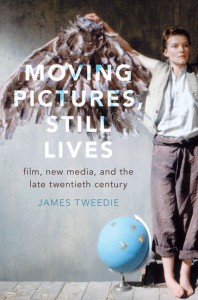
Moving Pictures, Still Lives
Film, New Media, and the Late Twentieth Century


 (0 vote)
Average rating:
| 0 | rating |  = We can do without = We can do without |
| 0 | rating |  = Good book = Good book |
| 0 | rating |  = Excellent book = Excellent book |
| 0 | rating |  = Unique / a reference = Unique / a reference |
Your rating: -
Book Presentation:
• Introduces the concept of the archaeomodern
• Connects cinema to other visual media, including painting
• Explores later works of Terence Davies, Jean-Luc Godard, and Agnes Varda
Moving Pictures, Still Lives revisits the cinematic and intellectual atmosphere of the late twentieth century. Against the backdrop of the historical fever of the 1980s and 1990sthe rise of the heritage industry, a global museum-building boom, and a cinematic fascination with costume dramas and literary adaptationsit explores the work of artists and philosophers who complicated the usual association between tradition and the past or modernity and the future. Author James Tweedie retraces the archaeomodern turn in films and theory that framed the past as a repository of abandoned but potentially transformative experiments. He examines late twentieth-century filmmakers who were inspired by old media, especially painting, and often viewed those art forms as portals to the modern past. In detailed discussions of Alain Cavalier, Terence Davies, Jean-Luc Godard, Peter Greenaway, Derek Jarman, Agnès Varda, and other key directors, the book concentrates on films that fill the screen with a succession of tableaux vivants, still lifes, illuminated manuscripts, and landscapes. It also considers three key figuresWalter Benjamin, Gilles Deleuze, and Serge Daneywho grappled with the late twentieth centurys characteristic concerns, including history, memory, and belatedness. It reframes their theoretical work on film as a mourning play for past revolutions and a means of reviving the possibilities of the modern age (and its paradigmatic medium, cinema) during periods of political and cultural retrenchment. Looking at cinema and the century in the rear-view mirror, the book highlights the unrealized potential visible in the history of film, as well as the cinematic phantoms that remain in the digital age.
About the Author:
James Tweedie, Associate Professor of Comparative Literature, University of Washington James Tweedie is Associate Professor of Comparative Literature at The University of Washington and author of The Age of New Waves: Art Cinema and the Staging of Globalization (2013), which won the 2014 Katherine Singer Kovacs book award from the Society for Cinema and Media Studies.
> From the same author:
The Age of New Waves (2013)
Art Cinema and the Staging of Globalization
Subject: Genre > Independent cinema
Cinema at the City's Edge (2010)
Film and Urban Networks in East Asia
Dir. Yomi Braester and James Tweedie
> On a related topic:
Contemporary Screen Ethics (2025)
Absences, Identities, Belonging, Looking Anew
Dir. Lucy Bolton, David Martin-Jones and Robert Sinnerbrink
Subject: Theory
Cinecepts, Deleuze, and Godard-Miéville (2025)
Developing Philosophy through Audiovisual Media
Subject: Theory
Cinema of/for the Anthropocene (2025)
Affect, Ecology, and More-Than-Human Kinship
Dir. Katarzyna Paszkiewicz and Andrea Ruthven
Subject: Theory
 Back
Back

