


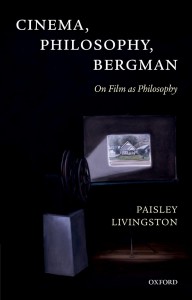
Cinema, Philosophy, Bergman
On Film as Philosophy


 (0 vote)
Average rating:
| 0 | rating |  = We can do without = We can do without |
| 0 | rating |  = Good book = Good book |
| 0 | rating |  = Excellent book = Excellent book |
| 0 | rating |  = Unique / a reference = Unique / a reference |
Your rating: -
Book Presentation:
The increasingly popular idea that cinematic fictions can "do" philosophy raises some difficult questions. Who is actually doing the philosophizing? Is it the philosophical commentator who reads general arguments or theories into the stories conveyed by a film? Could it be the filmmaker, or a group of collaborating filmmakers, who raise and try to answer philosophical questions with a film? Is there something about the experience of films that is especially suited to the stimulation of worthwhile philosophical reflections? In the first part of this book, Paisley Livingston surveys positions and arguments surrounding the cinema's philosophical value. He raises criticisms of bold theses in this area and defends a moderate view of film's possible contributions to philosophy. In the second part of the book he defends an intentionalist approach that focuses on the filmmakers' philosophical background assumptions, sources, and aims. Livingston outlines intentionalist interpretative principles as well as an account of authorship in cinema. The third part of the book exemplifies this intentionalist approach with reference to the work of Ingmar Bergman. Livingston explores the connection between Bergman's work and the Swedish director's primary philosophical source--a treatise in philosophical psychology authored by the Finnish philosopher, Eino Kaila. Bergman proclaimed that reading this book was a tremendous philosophical experience for him and that he "built on this ground." With reference to materials in the newly created Ingmar Bergman archive, Livingston shows how Bergman took up Kaila's topics in his cinematic explorations of motivated irrationality, inauthenticity, and the problem of self-knowledge.
About the Author:
Paisley Livingston has a BA in Philosophy from Stanford University and a PhD from The Johns Hopkins University. He is Chair Professor of Philosophy and Dean of Humanities at Lingnan University in Hong Kong. He has held teaching and research positions at The University of Michigan, Ann Arbor, McGill University, l'Ecole Polytechnique (Paris), Siegen University, the University of Aarhus, Roskilde University Center, the University of Copenhagen, and Zinbin (Kyoto). His last book was Art and Intention (Oxford: Clarendon). His other books are Ingmar Bergman and the Rituals of Art (Cornell), Literary Knowledge (Cornell), Literature and Rationality (Cambridge), and Models of Desire (Johns Hopkins). He co-edited The Creation of Art (Cambridge) with Berys Gaut and The Routledge Companion to Philosophy and Film with Carl Plantinga.
Press Reviews:
Review from previous edition: "Livingston's book covers an impressive amount of territory in an exceptionally clear, and often lively, fashion. He is rigorous and yet generous with argumentative opponents. The book balances abstract, conceptual argument with the close analysis of particular films and sequences very effectively." --Notre Dame Philosophical Reviews
> From the same author:
The Routledge Companion to Philosophy and Film (2011)
Dir. Paisley Livingston and Carl Plantinga
Subject: Theory
> On a related topic:
Contemporary Screen Ethics (2025)
Absences, Identities, Belonging, Looking Anew
Dir. Lucy Bolton, David Martin-Jones and Robert Sinnerbrink
Subject: Theory
Cinecepts, Deleuze, and Godard-Miéville (2025)
Developing Philosophy through Audiovisual Media
Subject: Theory
Cinema of/for the Anthropocene (2025)
Affect, Ecology, and More-Than-Human Kinship
Dir. Katarzyna Paszkiewicz and Andrea Ruthven
Subject: Theory
 Back
Back

