


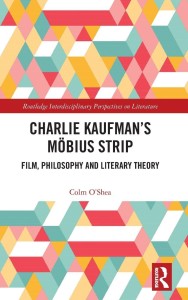
Charlie Kaufman's Möbius Strip
Film, Philosophy and Literary Theory
by Colm O’Shea


 (0 vote)
Average rating:
| 0 | rating |  = We can do without = We can do without |
| 0 | rating |  = Good book = Good book |
| 0 | rating |  = Excellent book = Excellent book |
| 0 | rating |  = Unique / a reference = Unique / a reference |
Your rating: -
Book Presentation:
Charlie Kaufman’s Möbius Strip: Film, Philosophy and Literary Theory presents Kaufman’s diagnosis of alienation and corruption in the modern age as a fundamentally spiritual malady.
Each chapter builds on a theological or metaphysical idea, drawing from thinkers as diverse as Kierkegaard, Kafka, Wittgenstein, and David Foster Wallace, along with spiritual insights from the Talmud, Tibetan Buddhism, and Christian mysticism. This isn’t to sell the notion that Charlie Kaufman is a covert religious thinker of any particular stripe. Instead, the book reveals how, behind the surreal whimsy, playfulness, and absurdity of his fictional universes, Kaufman’s films collectively present an accurate anatomy of contemporary despair or broken heartedness.
Kaufman’s critique engages in what this book terms a “meta-modernity”―a dual mode that oscillates from postmodern irony to sincere engagement with human suffering and angst. The Kaufmanesque text is openly vulnerable and guarded, direct and oblique, playful and lamenting. This book offers an essential guide to understanding Kaufman’s unique cinematic vision and its profound engagement with the spiritual crises of our time.
About the Author:
Colm O’Shea is a clinical professor of writing at New York University. His other academic monograph for Routledge is James Joyce’s Mandala (2022), which also examines the twin poles of the mystic and morbid in experimental fiction.
See the publisher website: Routledge
> On a related topic:
Artificial Generation (2021)
Photogenic French Literature and the Prehistory of Cinematic Modernity
Subject: Technique > Adaptation
Towards a Feminist Cinematic Ethics (2026)
Claire Denis, Emmanuel Levinas and Jean-Luc Nancy
Subject: Theory
Contemporary Screen Ethics (2025)
Absences, Identities, Belonging, Looking Anew
Dir. Lucy Bolton, David Martin-Jones and Robert Sinnerbrink
Subject: Theory

Cinecepts, Deleuze, and Godard-Miéville (2025)
Developing Philosophy through Audiovisual Media
Subject: Theory
Cinema of/for the Anthropocene (2025)
Affect, Ecology, and More-Than-Human Kinship
Dir. Katarzyna Paszkiewicz and Andrea Ruthven
Subject: Theory
 Back
Back

