


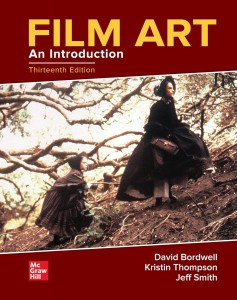
Film Art
An Introduction
by David Bordwell, Kristin Thompson and Jeff Smith


 (0 vote)
Average rating:
| 0 | rating |  = We can do without = We can do without |
| 0 | rating |  = Good book = Good book |
| 0 | rating |  = Excellent book = Excellent book |
| 0 | rating |  = Unique / a reference = Unique / a reference |
Your rating: -
Book Presentation:
Film is an art form with a language and an aesthetic all its own. Since 1979, Film Art has been the best-selling and most widely respected introduction to the analysis of cinema. Taking a skills-centered approach supported by examples from many periods and countries, the authors help students develop a core set of analytical skills that will enrich their understanding of any film, in any genre. In-depth examples deepen students' appreciation for how creative choices by filmmakers affect what viewers experience and how they respond. Film Art is generously illustrated with more than 1,000 frame enlargements taken directly from completed films, providing concrete illustrations of key concepts. Its Connect program includes invaluable tutorials featuring canonic film clips from the Criterion Collection. The thirteenth edition of Film Art includes extensively updated examples, and expanded coverage of digital filmmaking and the artistic and commercial implications of streaming.
About the authors:
David Bordwell is Jacques Ledoux Professor Emeritus of Film Studies in the Department of Communication Arts at the University of Wisconsin–Madison. He also holds a Hilldale Professorship in the Humanities and an Honorary Doctorate from the University of Copenhagen. He has also held the Kluge Chair in Modern Culture at the Library of Congress. His books include Narration in the Fiction Film (University of Wisconsin Press, 1985), On the History of Film Style (Harvard University Press, 1997), Planet Hong Kong: Popular Cinema and the Art of Entertainment (Harvard University Press, 2000; 2nd ed., Irvington Way Institute Press, 2011), Figures Traced in Light: On Cinematic Staging(University of California Press, 2005), The Way Hollywood Tells It: Story and Style in Modern Movies (University of California Press, 2006), The Rhapsodes: How 1940s Critics Changed American Film Culture (University of Chicago Press, 2016), and Reinventing Hollywood: How 1940s Filmmakers Changed Movie Storytelling (University of Chicago Press, 2017). He has also written books on Carl Theodor Dreyer, Yasujiro Ozu, Sergei Eisenstein, digital cinema, and Hong Kong film.Jeff Smith is a Professor of Film Studies in the Department of Communication Arts at the University of Wisconsin―Madison, where he earned his Ph.D. He is the author of two books: The Sounds of Commerce: Marketing Popular FilmMusic (1998) and Film Criticism, the Cold War, and the Blacklist: Reading the Hollywood Reds (2014). He has also published several articles and book chapters on the role of sound and music in American cinema. He is currently at work on a book that traces development of the classical Hollywood film score during the 1930s that examines how studios allocated musical resources to films based on their position within the hierarchy of prestige pictures, programmers, and “B” films.Kristin Thompson is an Honorary Fellow in the Department of Communication Arts at the University of Wisconsin―Madison, where she earned her Ph.D. Her books include Eisenstein’s Ivan the Terrible (1981), Exporting Entertainment: America’s Place in World Film Markets 1901–1934 (1985), Breaking the Glass Armor: Neoformalist Film Analysis (1988), Storytelling in the New Hollywood: Understanding Classical Narrative Technique (1999), Herr Lubitsch Goes to Hollywood: German and American Film after World War I (2005), and The Frodo Franchise: The Lord of the Rings and Modern Hollywood (2007).
See the publisher website: McGraw-Hill
> From the same authors:
Perplexing Plots (2023)
Popular Storytelling and the Poetics of Murder
Film History (2021)
An Introduction
by Kristin Thompson, David Bordwell and Jeff Smith
Subject: History of Cinema
Reinventing Hollywood (2017)
How 1940s Filmmakers Changed Movie Storytelling
Subject: History of Cinema
The Classical Hollywood Cinema (2015)
Film Style and Mode of Production to 1960
Film Criticism, the Cold War, and the Blacklist (2014)
Reading the Hollywood Reds
by Jeff Smith
Subject: History of Cinema
Minding Movies (2011)
Observations on the Art, Craft, and Business of Filmmaking
by David Bordwell and Kristin Thompson
Subject: General
The Frodo Franchise (2007)
The Lord of the Rings and Modern Hollywood
Subject: One Film > The Lord of the Rings
Herr Lubitsch Goes to Hollywood (2005)
German and American Film after World War I
Subject: Director > Ernst Lubitsch
Planet Hong Kong (2000)
Popular Cinema and the Art of Entertainment
Storytelling in the New Hollywood (1999)
Understanding Classical Narrative Technique
Subject: Technique > Scriptwriting
> On a related topic:
New Takes on Film and Imagination (2020)
Paragraph, Volume 43, Issue 3
Dir. Sarah Cooper
Subject: Theory
V. F. Perkins on Movies (2020)
Collected Shorter Film Criticism
Dir. V. F. Perkins and Douglas Pye
Subject: Theory
Thinking in the Dark (2015)
Cinema, Theory, Practice
Dir. Murray Pomerance and R. Barton Palmer
Subject: Theory
 Back
Back

