


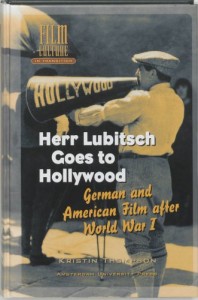
Herr Lubitsch Goes to Hollywood
German and American Film after World War I


 (0 vote)
Average rating:
| 0 | rating |  = We can do without = We can do without |
| 0 | rating |  = Good book = Good book |
| 0 | rating |  = Excellent book = Excellent book |
| 0 | rating |  = Unique / a reference = Unique / a reference |
Your rating: -
Book Presentation:
Ernst Lubitsch, the German filmmaker who left Berlin for Hollywood in the 1920s, is best remembered today for the famous "Lubitsch touch" in such masterpieces as Ninotchka, which featured Greta Garbo's first-ever screen smile, and Heaven Can Wait. Kristin Thompson's study analyzes Lubitsch's earlier silent films of 1918 to 1927 in order to trace the mutual influences between the classical Hollywood film style as it had evolved in the 1910s and the German film industry of the same period, which had emerged from World War I second in strength only to Hollywood.
During World War I, American firms supplied theaters around the world as French and Italian films had become scarce. Ironically, the war strengthened German filmmaking due to a ban on imports that lasted until 1921. During that period of isolation, Lubitsch became the finest proponent of German filmmaking and once Hollywood films appeared in Germany again Lubitsch was quick to absorb their stylistic traits as well. He soon became the unique master of both styles as the golden ages of the American and German cinema were beginning. This innovative study utilizes Lubitsch's silent films as a means to compare two great national cinemas at a vital formative period in cinema history.
About the Author:
Kristin Thompson is an honorary fellow at the department of communications arts at the University of Wisconsin, Madison.
See the publisher website: Amsterdam University Press
See the complete filmography of Ernst Lubitsch on the website: IMDB ...
> From the same author:
Film History (2021)
An Introduction
by Kristin Thompson, David Bordwell and Jeff Smith
Subject: History of Cinema
The Classical Hollywood Cinema (2015)
Film Style and Mode of Production to 1960
Minding Movies (2011)
Observations on the Art, Craft, and Business of Filmmaking
by David Bordwell and Kristin Thompson
Subject: General
The Frodo Franchise (2007)
The Lord of the Rings and Modern Hollywood
Subject: One Film > The Lord of the Rings

Storytelling in the New Hollywood (1999)
Understanding Classical Narrative Technique
Subject: Technique > Scriptwriting
> On a related topic:
Weimar Cinema, Embodiment, and Historicity (2019)
Cultural Memory and the Historical Films of Ernst Lubitsch

The Films of Douglas Sirk (2019)
Exquisite Ironies and Magnificent Obsessions
by Tom Ryan
Subject: Director > Douglas Sirk
New Approaches to Ernst Lubitsch (2024)
A Light Touch
Dir. Brigitte Peucker and Ido Lewit
Subject: Director > Ernst Lubitsch
The Ethics of Ernst Lubitsch (2024)
Comedy Without Relief
by Gregor Moder and Ivana Novak
Subject: Director > Ernst Lubitsch
Sex, Politics, and Comedy (2020)
The Transnational Cinema of Ernst Lubitsch
Subject: Director > Ernst Lubitsch
Lubitsch Can't Wait (2014)
A Collection of Ten Philosophical Discussions on Ernst Lubitsch's Film Comedy
Dir. Ivana Novak, Mladen Dolar and Jela Krečič
Subject: Director > Ernst Lubitsch
 Back
Back

