


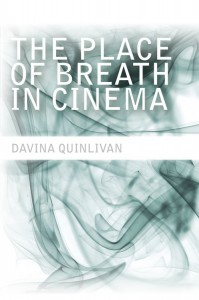
The Place of Breath in Cinema


 (0 vote)
Average rating:
| 0 | rating |  = We can do without = We can do without |
| 0 | rating |  = Good book = Good book |
| 0 | rating |  = Excellent book = Excellent book |
| 0 | rating |  = Unique / a reference = Unique / a reference |
Your rating: -
Book Presentation:
How can the cinema articulate the interstices between visibility and invisibility, and how are such notions of absence and the unseen implicated in the film experience? This study considers the locus of the breathing body in the film experience and its implications for the study of embodiment in film and sensuous spectatorship. Quinlivan puts forward a mode of critical engagement with film shaped by the foregrounding of the human body in the filmic diegesis and the viewing experience. The book's foregrounding of the human body as an, importantly, breathing body in film, coupled with its fresh engagement with continental philosophy, Post-Structuralist Film Theory and Contemporary Western Cinema, makes a unique and valuable contribution to the field.
Key features:
• Case studies are taken from the work of major directors, including David Cronenberg, Atom Egoyan and Lars von Trier
• Key concepts explored are filmic space (air and the elemental in film), corporeality (bodies on screen and the film itself as a breathing body) and inter-subjectivity (community and sociality)
• Makes a notable contribution to the study of film sound and haptic perception
About the Author:
Davina Quinlivan is an independent critic and writer, as well as part-time lecturer in Film Studies at King's College, London and Kingston University.
Press Reviews:
As The Place of Breath in Cinema unfolds, Quinlivan documents how an expansive notion of "breathing" makes filmmakers as disparate as Egoyan, Cronenberg, and von Trier into a coherent set. They telegraph different aspects of her governing trope but coalesce, too, around shared questions. Meanwhile, the book’s arc and its prose operate like the alveoli in the lungs: with every potent parallel or counter-intuitive provocation, but even when a claim feels over-stretched or under-illustrated, Quinlivan’s ideas achieve an impressive alchemy. She turns images that might read one way into vessels for very different and generative thoughts. Distinctive, unpredictable, and eager for readers to test its frameworks against other subjects (Campion? Kunuk? Ceylan? Kawase?), The Place of Breath in Cinema reimagines breathing, the literal act of invigoration, and thereby fosters its intellectual equivalent.– Nick Davies, Cinema Journal
Associated with the soul, animating the lungs, breath is that invisible and usually intangible entity that makes its passage known sonically. Davina Quinlivan demonstrates with precision, grace, and acute attention to cinematic sound how the cinema can embody both the environments we inhale and the interiorities we exhale.– Dr Laura U. Marks, Simon Fraser University, Vancouver
Davina Quinlivan's distinctive volume newly attends to the body in cinema. With infinite delicacy, her readings of recent films attach breathing and vision, opening vivid questions of spatiality, contemplation, invisibility, and rhythm.– Emma Wilson, University of Cambridge
Davina Quinlivan's distinctive volume newly attends to the body in cinema. With infinite delicacy, her readings of recent films attach breathing and vision, opening vivid questions of spatiality, contemplation, invisibility, and rhythm.– Emma Wilson, University of Cambridge
> From the same author:

Radical Embodiment on Film (2026)
Time and the Cinematic Body
Dir. Louis Bayman and Davina Quinlivan
Subject: Theory
> On a related topic:
Dreams and Atrocity (2023)
The Oneiric in Representations of Trauma
Dir. Emily-Rose Baker and Diane Otosaka
Subject: Theory

Terminal identity (1993)
the virtual subject in postmodern science fiction
Subject: Genre > Science Fiction
Filmmakers on Film (2026)
Global Perspectives
Dir. André Rui Graça, Manuela Penafria and Eduardo Tulio Baggio
Subject: Theory
 Back
Back

