

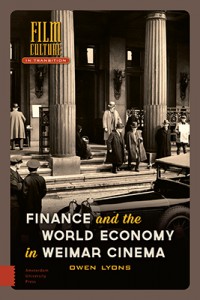
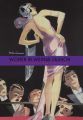
Finance and the World Economy in Weimar Cinema
de Owen Lyons


 (0 vote)
Moyenne des votes :
| 0 | vote |  = On peut s'en passer = On peut s'en passer |
| 0 | vote |  = Bon livre = Bon livre |
| 0 | vote |  = Excellent livre = Excellent livre |
| 0 | vote |  = Unique / une référence = Unique / une référence |
Votre vote : -
Description de l'ouvrage:
After the First World War, the effects of financial crisis could be felt in all corners of the newly formed Weimar Republic. The newly interconnected world economy was barely understood and yet it was increasingly made visible in the films of the time. The complexities of this system were reflected on screen to both the everyday spectator as well as a new class of financial workers who looked to popular depictions of speculation and crisis to make sense of their own place on the shifting ground of modern life. Finance and the World Economy in Weimar Cinema turns to the many underexamined depictions of finance capital that appear in the films of 1920s Germany. The representation of finance capital in these films is essential to our understanding of the culture of the Weimar Republic - particularly in the relation between finance and ideas of gender, nation and modernity. As visual records, these films reveal the stock exchange as a key space of modernity and coincide with the abstraction of finance as a vast labour of representation in its own right. In so doing, they introduce core visual tropes that have become essential to our understanding of finance and capitalism throughout the twentieth century.
À propos de l'auteur :
Owen Lyons is an Assistant Professor at the School of Image Arts at Toronto Metropolitan University and holds a PhD in Cultural Mediations from Carleton University. His research addresses Weimar Cinema as well as the visual culture of twenty-first century financial markets.
Voir le site internet de l'éditeur Amsterdam University Press
> Sur un thème proche :
Film Societies in Germany and Austria 1910-1933 (2023)
Tracing the Social Life of Cinema

The Hygienic Apparatus (2022)
Weimar Cinema and Environmental Disorder
The Long Century's Long Shadow (2021)
Weimar Cinema and the Romantic Modern
Weimar Cinema, Embodiment, and Historicity (2019)
Cultural Memory and the Historical Films of Ernst Lubitsch
Cinematography in the Weimar Republic (2018)
Lola Lola, Dirty Singles, and the Men Who Shot Them
 Retour