

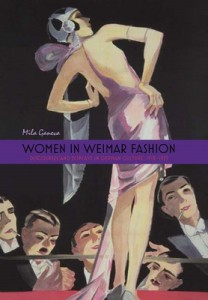
Women in Weimar Fashion
Discourses and Displays in German Culture, 1918-1933
by Mila Ganeva


 (0 vote)
Average rating:
| 0 | rating |  = We can do without = We can do without |
| 0 | rating |  = Good book = Good book |
| 0 | rating |  = Excellent book = Excellent book |
| 0 | rating |  = Unique / a reference = Unique / a reference |
Your rating: -
Book Presentation:
New view of the crucial role of fashion discourse and practice in Weimar Germany and its significance for women.
In the Weimar Republic, fashion was not only manipulated by the various mass media -- film, magazines, advertising, photography, and popular literature -- but also emerged as a powerful medium for women's self-expression. Female writers and journalists, including Helen Grund, Irmgard Keun, Vicki Baum, Elsa Maria Bug, and numerous others engaged in a challenging, self-reflective commentary on current styles. By regularly publishing on these topics in the illustrated press and popular literature, they transformed traditional genres and carved out significant public space for themselves. This book re-evaluates paradigmatic concepts of German modernism such as the fl neur, the Feuilleton, and Neue Sachlichkeit in the light of primary material unearthed in archival research: fashion vignettes, essays, short stories, travelogues, novels, films, documentaries, newsreels, and photographs. Unlike other studies of Weimar culture that have ignored the crucial role of fashion, the book proposes a new genealogy of women's modernity by focusing on the discourse and practice of Weimar fashion, in which the women were transformed from objects of male voyeurism into subjects with complex, ambivalent, and constantly shifting experiences of metropolitan modernity.
Mila Ganeva is Associate Professor of German at Miami University, Oxford, Ohio.
See the publisher website: Camden House
> From the same author:
> On a related topic:

Joyless Streets (1989)
Women and Melodramatic Representation in Weimar Germany

Film Societies in Germany and Austria 1910-1933 (2023)
Tracing the Social Life of Cinema

Rethinking Jewishness in Weimar Cinema (2023)
Dir. Barbara Hales and Valerie Weinstein

The Hygienic Apparatus (2022)
Weimar Cinema and Environmental Disorder
The Long Century's Long Shadow (2021)
Weimar Cinema and the Romantic Modern
Weimar Cinema, Embodiment, and Historicity (2019)
Cultural Memory and the Historical Films of Ernst Lubitsch
Cinematography in the Weimar Republic (2018)
Lola Lola, Dirty Singles, and the Men Who Shot Them
 Back
Back