

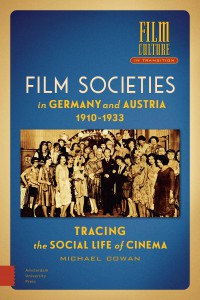
Film Societies in Germany and Austria 1910-1933
Tracing the Social Life of Cinema


 (0 vote)
Moyenne des votes :
| 0 | vote |  = On peut s'en passer = On peut s'en passer |
| 0 | vote |  = Bon livre = Bon livre |
| 0 | vote |  = Excellent livre = Excellent livre |
| 0 | vote |  = Unique / une référence = Unique / une référence |
Votre vote : -
Description de l'ouvrage:
This study traces the evolution of early film societies in Germany and Austria, from the emergence of mass movie theaters in the 1910s to the turbulent years of the late Weimar Republic. Examining a diverse array of groups, it approaches film societies as formations designed to assimilate and influence a new medium: a project emerging from the world of amateur science before taking new directions into industry, art and politics. Through an interdisciplinary approach--in dialogue with social history, print history and media archaeology--it also transforms our theoretical understanding of what a film society was and how it operated. Far from representing a mere collection of pre-formed cinephiles, film societies were, according to the book's central argument, productive social formations, which taught people how to nurture their passion for the movies, how to engage with cinema, and how to interact with each other. Ultimately, the study argues that examining film societies can help to reveal the diffuse agency by which generative ideas of cinema take shape.
À propos de l'auteur :
Michael Cowan is Professor of film and media history in the Department of Cinematic Arts at the University of Iowa. His research, focused on German and European cinema, examines the broader cultural and technological contexts in which film practices emerged and evolved in the early 20th century. His publications have won numerous awards from the Society of Film and Media Studies and the British Association of Film and Television Studies Scholars, as well as the Willy Haas Award (Germany) and the Limina Award (Italy).
Voir le site internet de l'éditeur Amsterdam University Press
> Du même auteur :
The Promise of Cinema (2016)
German Film Theory, 1907–1933
Dir. Anton Kaes, Nicholas Baer et Michael Cowan
Sujet : Theory
Walter Ruttmann and the Cinema of Multiplicity (2014)
Avant-Garde - Advertising - Modernity
Sujet : Director > Walter Ruttmann
> Sur un thème proche :
Joyless Streets (1989)
Women and Melodramatic Representation in Weimar Germany
Sensitive Subjects (2020)
The Political Aesthetics of Contemporary German and Austrian Cinema
Framed Visions (1998)
Popular Culture, Americanization, and the Contemporary German and Austrian Imagination
Sujet : Sociology

100 Facts about Babelsberg (2021)
Cradle of film and modern Media City
de Sebastian Stielke
(en allemand et anglais)

Homo Cinematicus (2017)
Science, Motion Pictures, and the Making of Modern Germany
 Retour