

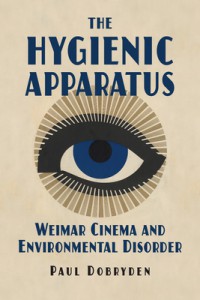
The Hygienic Apparatus
Weimar Cinema and Environmental Disorder


 (0 vote)
Average rating:
| 0 | rating |  = We can do without = We can do without |
| 0 | rating |  = Good book = Good book |
| 0 | rating |  = Excellent book = Excellent book |
| 0 | rating |  = Unique / a reference = Unique / a reference |
Your rating: -
Book Presentation:
This study traces how the environmental effects of industrialization reverberated through the cinema of Germany’s Weimar Republic. In the early twentieth century, hygiene encompassed the myriad attempts to create healthy spaces for life and work amid the pollution, disease, accidents, and noise of industrial modernity. Examining classic films—including The Last Laugh, Faust, and Kuhle Wampe—as well as documentaries, cinema architecture, and studio practices, Paul Dobryden demonstrates how cinema envisioned and interrogated hygienic concerns about environmental disorder.
Framing hygiene within the project of national reconstruction after World War I, The Hygienic Apparatus explores cinema’s material contexts alongside its representations of housework, urban space, traffic, pollution, disability, aging, and labor. Reformers worried about the health risks associated with moviegoing but later used film to popularize hygienic ideas, encouraging viewers to see the world and themselves in relation to public health objectives. Modernist architecture and design fashioned theaters into regenerative environments for fatigued spectators. Filmmakers like F. W. Murnau and Slatan Dudow, meanwhile, explored the aesthetic and political possibilities of dirt, contagion, intoxication, and disorder. Dobryden recovers a set of ecological and biopolitical concerns to show how the problem of environmental disorder fundamentally shaped cinema’s relationship to modernity. As accessible as it is persuasive, the book adds to a growing body of scholarship on biopolitics within German studies and reveals fresh ways of understanding the apparatus of Weimar cinema.
About the Author:
PAUL DOBRYDEN is an assistant professor in the Department of Germanic Languages and Literatures at the University of Virginia.
Press Reviews:
"This study brilliantly unpacks the imbrications between early German cinema and a pervasive concern with hygiene, understood as a set of ideas and techniques for managing the interactions between bodies and environments. Dobryden shows how hygienic thinking impacted not only filmic representations and the development of distinct genres, but also the understanding of cinema more broadly: its spaces of production and reception, its technological development, and its power to bolster or disrupt the disciplinary regimes of industrial capitalism." —Michael Cowan, author of Walter Ruttmann and the Cinema of Multiplicity: Avant-Garde Film—Advertising—Modernity
"The Hygienic Apparatus beautifully weaves together two aspects of German modernity that are usually considered separately: the simultaneously unfolding trajectories of hygienic discourse and of cinema during the early decades of the twentieth century. It demonstrates on the one hand how nonfiction films on topics as diverse as the design of urban and domestic space, the perils of big city traffic, and sexual and reproductive life helped define a new hygienic imaginary, and on the other hand how feature films forged a counter-hygienic alternative to the powerfully normative schemas that emerged from the modern obsession with efficiency, order and health." —Andreas Killen, author of Homo Cinematicus: Science, Motion Pictures, and the Making of Modern Germany
"In this superb reconsideration of Weimar cinema, Paul Dobryden places film at the heart of a struggle for environmental and hygienic control that is at once fascinating and unnervingly timely. Connecting architecture and infrastructure, biopolitics and disability, and both canonical and forgotten figures of early German cinema, The Hygienic Apparatus offers a model of how capacious cultural film histories should be written and important lessons for scholars of German history and the environmental humanities." —Brian R. Jacobson, author of Studios Before the System: Architecture, Technology, and the Emergence of Cinematic Space
> On a related topic:
The Uncanny Gaze (2010)
The Drama of Early German Cinema
The Long Century's Long Shadow (2021)
Weimar Cinema and the Romantic Modern

Berlin Alexanderplatz (2009)
Radio, Film, and the Death of Weimar Culture
Weimar Cinema and After (2000)
Germany's Historical Imaginary

From Caligari to Hitler (2019)
A Psychological History of the German Film
 Back
Back