


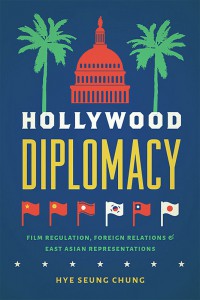
Hollywood Diplomacy
Film Regulation, Foreign Relations, and East Asian Representations


 (0 vote)
Moyenne des votes :
| 0 | vote |  = On peut s'en passer = On peut s'en passer |
| 0 | vote |  = Bon livre = Bon livre |
| 0 | vote |  = Excellent livre = Excellent livre |
| 0 | vote |  = Unique / une référence = Unique / une référence |
Votre vote : -
Description de l'ouvrage:
Hollywood Diplomacy contends that, rather than simply reflect the West’s cultural fantasies of an imagined “Orient,” images of Chinese, Japanese, and Korean ethnicities have long been contested sites where the commercial interests of Hollywood studios and the political mandates of U.S. foreign policy collide, compete against one another, and often become compromised in the process. While tracing both Hollywood’s internal foreign relations protocols—from the “Open Door” policy of the silent era to the “National Feelings” provision of the Production Code—and external regulatory interventions by the Chinese government, the U.S. State Department, the Office of War Information, and the Department of Defense, Hye Seung Chung reevaluates such American classics as Shanghai Express and The Great Dictator and applies historical insights to the controversies surrounding contemporary productions including Die Another Day and The Interview. This richly detailed book redefines the concept of “creative freedom” in the context of commerce: shifting focus away from the artistic entitlement to offend foreign audiences toward the opportunity to build new, better relationships with partners around the world through diplomatic representations of race, ethnicity, and nationality.
À propos de l'auteur :
Hye Seung Chung is an associate professor of film and media studies at Colorado State University in Fort Collins, Colorado. She is the author of Hollywood Asian: Philip Ahn and the Politics of Cross-Ethnic Performance and Kim Ki-duk, as well as the co-author of Movie Migrations: Transnational Genre Flows and South Korean Cinema.
Revue de Presse:
"Deeply rooted in sound documentation and rigorous archival study but also imaginative and subtle in the interpretive work it accomplishes, Hollywood Diplomacy offers a fresh and vital account of the censorship and regulation that surrounds Asian and Asian American representation in film."
— Ellen Scott
"The first comprehensive study of Hollywood’s regulation of East Asian representation. A rigorously-researched and important illumination of the impact of politics, protest, and profit on Hollywood’s representation of race."
— Philippa Gates
"The book provides a new and fresh understanding of how policies, censorship, and the propaganda machine can influence screenwriters, directors, and production companies. A deft combination of history and textual analysis, Hollywood Diplomacy provides insight into how Hollywood has often wrongly represented East Asian people and then attempted to save face and money by editing out those problematic representations. Essential."
— Choice
"Hollywood Diplomacy provides great contribution to scholarship not simply on Asian representation on film, but toward providing a much-needed book-length contribution toward better understanding the tensions between foreign censorship boards as well as the progression of Hollywood’s foreign policy at large."
— Historical Journal of Film, Radio, and Television
> Du même auteur :

Cinema under National Reconstruction (2024)
State Censorship and South Korea's Cold War Film Culture
Movie Minorities (2021)
Transnational Rights Advocacy and South Korean Cinema

Movie Migrations (2015)
Transnational Genre Flows and South Korean Cinema

Hollywood Asian (2006)
Philip Ahn and the Politics of Cross-Ethnic Performance
Sujet : Actor > Philip Ahn
> Sur un thème proche :

Cinema Civil Rights (2015)
Regulation, Repression, and Race in the Classical Hollywood Era
Sujet : Sociology

Walls without Cinema (2022)
State Security and Subjective Embodiment in Twenty-First-Century US Filmmaking
Sujet : Sociology
Civil Servants on the Silver Screen (2019)
Hollywood's Depiction of Government and Bureaucrats
Sujet : Sociology
 Retour

