


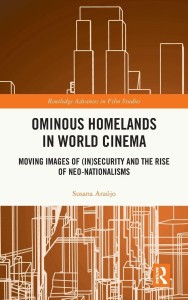
Ominous Homelands in World Cinema


 (0 vote)
Average rating:
| 0 | rating |  = We can do without = We can do without |
| 0 | rating |  = Good book = Good book |
| 0 | rating |  = Excellent book = Excellent book |
| 0 | rating |  = Unique / a reference = Unique / a reference |
Your rating: -
Book Presentation:
Ominous Homelands in World Cinema examines contemporary films from a range of national settings that expose and critically engage with representations of “Homeland” – a term that resurfaced with renewed intensity in the United States through the establishment of the Department of Homeland Security after 9/11 and gained traction across Europe, contributing to the formation of new securitarian configurations whose impact has resonated globally.
By drawing on contemporary films from different national contexts, and relating these with emerging political discourses, this book explores some of the new meanings and images associated with ideas of home and land. The analysis also traces how notions and representations of “Homeland” in popular culture have increasingly become infused with themes of security and control, not only linked to terrorism but also progressively connected to a number of other global processes such as the so-called “refugee crisis,” the emergence of new geopolitical powers, wars and the rise of authoritarian leaders and nationalistic movements in different parts of the world.
This book will be of interest to students and scholars in media and film studies, American studies, cultural studies, critical security studies, international relations, contemporary history and global studies.
About the Author:
Susana Araújo is a tenured professor at the Faculty of Arts and Humanities at the University of Coimbra, Portugal and an integrated researcher at CEComp, Faculty of Arts and Humanities at the University of Lisbon, Portugal. She is the author of the monograph Transatlantic Fictions of 9/11 and the War on Terror: Images of Terror, Narratives of Captivity which was selected as an Outstanding Academic Title by Choice in 2016, as well as several books of poetry and poetic prose. She has published widely in recognised journals such as the European Journal of English Studies, Atlantic Studies, Studies in the Novel, Women Studies, Critical Survey, Symbiosis and Review of International American Studies. She served as vice-director of the Comparative Studies Research Centre (CEComp), where she also coordinated Group Locus and led several national and international funded projects, including the FCT Project CILM - City and (In)security in Literature and the Media.
See the publisher website: Routledge
> On a related topic:
Cinema and the Wealth of Nations (2017)
Media, Capital, and the Liberal World System
Subject: Sociology
Film Propaganda and American Politics (2015)
An Analysis and Filmography
by James Combs and Sara T. Combs
Subject: Sociology
The Invisible Hand in Popular Culture (2012)
Liberty vs. Authority in American Film and TV
Subject: Sociology
Policing Show Business (2024)
J. Edgar Hoover, the Hollywood Blacklist, and Cold War Movies
Subject: Countries > United States

Un-American Psycho (2012)
Brian De Palma and the Political Invisible
by Chris Dumas
Subject: Director > Brian de Palma
Hollywood and the CIA (2012)
Cinema, Defense and Subversion
by Oliver Boyd Barrett, David Herrera and James Baumann
Subject: Countries > United States
Hollywood and Anticommunism (2009)
HUAC and the Evolution of the Red Menace, 1935-1950
Subject: Countries > United States
 Back
Back

