

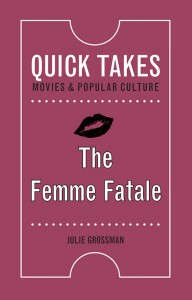
The Femme Fatale


 (0 vote)
Moyenne des votes :
| 0 | vote |  = On peut s'en passer = On peut s'en passer |
| 0 | vote |  = Bon livre = Bon livre |
| 0 | vote |  = Excellent livre = Excellent livre |
| 0 | vote |  = Unique / une référence = Unique / une référence |
Votre vote : -
Description de l'ouvrage:
Ostensibly the villain, but also a model of female power, poise, and intelligence, the femme fatale embodies Hollywood’s contradictory attitudes toward ambitious women. But how has the figure of the femme fatale evolved over time, and to what extent have these changes reflected shifting cultural attitudes toward female independence and sexuality?
This book offers readers a concise look at over a century of femmes fatales on both the silver screen and the TV screen. Starting with ethnically exoticized silent film vamps like Theda Bara and Pola Negri, it examines classic film noir femmes fatales like Barbara Stanwyck in Double Indemnity, as well as postmodern revisions of the archetype in films like Basic Instinct and Memento. Finally, it explores how contemporary film and television creators like Fleabag and Killing Eve’s Phoebe Waller-Bridge have appropriated the femme fatale in sympathetic and surprising ways.
Analyzing not only the films themselves, but also studio press kits and reviews, The Femme Fatale considers how discourses about the pleasures and dangers of female performance are projected onto the figure of the femme fatale. Ultimately, it is a celebration of how “bad girl” roles have provided some of Hollywood’s most talented actresses opportunities to fully express their on-screen charisma.
À propos de l'auteur :
JULIE GROSSMAN is a professor of English and communication and film studies at Le Moyne College in Syracuse, New York. Her books about film, television, literature, and gender include Ida Lupino, Director: Her Art and Resilience in Times of Transition (with Therese Grisham), Rethinking the Femme Fatale in Film Noir: Ready for Her Close-Up, Adaptation and ElasTEXTity: Literature, Film, and Their Hideous Progeny, and Twin Peaks (with Will Scheibel).
Revue de Presse:
"A fascinating exploration of Hollywood’s most notorious female that goes beyond film noir. With a focus on the performance of gender as subversive and empowered, Grossman illuminates over a century of femme fatales from silent cinema’s 'Vamp' Theda Bara to television’s Killing Eve."
— Philippa Gates
"In this lively and engaging book, Julie Grossman elegantly traces the long tradition of the femme fatale figure in film, television and popular culture. She deftly analyses a diverse range of characters, from Theda Bara’s vamp in early Hollywood, the hard-boiled dames of classic Film Noir, to the complex and vibrant Villanelle in contemporary television’s Killing Eve. Grossman persuasively illustrates the centrality of role performance to these femme fatale figures, and establishes performance as a key mode by which they resist inequalities in social structures. This book provides both a history of how women have been represented, and a compelling case for the relevance of the femme fatale to contemporary debates on gender politics."
— Helen Hanson
> Livres ayant un titre identique ou proche :

> Du même auteur :

Ida Lupino, Director (2017)
Her Art and Resilience in Times of Transition
de Therese Grisham et Julie Grossman
Sujet : Director > Ida Lupino
Literature, Film, and Their Hideous Progeny (2017)
Adaptation and ElasTEXTity
Sujet : Technique > Adaptation
> Sur un thème proche :

'Sluts' on the Small Screen (2024)
Female Promiscuity in Scripted American Television Series
Polyamory, Monogamy, and American Dreams (2019)
The Stories We Tell about Poly Lives and the Cultural Production of Inequality
Sujet : Sociology
 Retour

