


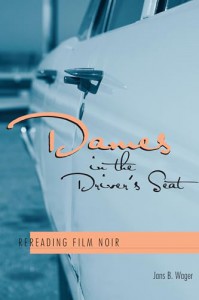
Dames in the Driver's Seat
Rereading Film Noir


 (0 vote)
Moyenne des votes :
| 0 | vote |  = On peut s'en passer = On peut s'en passer |
| 0 | vote |  = Bon livre = Bon livre |
| 0 | vote |  = Excellent livre = Excellent livre |
| 0 | vote |  = Unique / une référence = Unique / une référence |
Votre vote : -
Description de l'ouvrage:
With its focus on dangerous, determined femmes fatales, hardboiled detectives, and crimes that almost-but-never-quite succeed, film noir has long been popular with moviegoers and film critics alike. Film noir was a staple of classical Hollywood filmmaking during the years 1941-1958 and has enjoyed a resurgence in popularity since the 1990s. Dames in the Driver's Seat offers new views of both classical-era and contemporary noirs through the lenses of gender, class, and race. Jans Wager analyzes how changes in film noir's representation of women's and men's roles, class status, and racial identities mirror changes in a culture that is now often referred to as postmodern and postfeminist.
Following introductory chapters that establish the theoretical basis of her arguments, Wager engages in close readings of the classic noirs The Killers, Out of the Past, and Kiss Me Deadly and the contemporary noirs L. A. Confidential, Mulholland Falls, Fight Club, Twilight, Fargo, and Jackie Brown. Wager divides recent films into retro-noirs (made in the present, but set in the 1940s and 1950s) and neo-noirs (made and set in the present but referring to classic noir narratively or stylistically). Going beyond previous studies of noir, her perceptive readings of these films reveal that retro-noirs fulfill a reactionary social function, looking back nostalgically to outdated gender roles and racial relations, while neo-noirs often offer more revisionary representations of women, though not necessarily of people of color.
À propos de l'auteur :
Jans B. Wager is Associate Professor of English and Literature at Utah Valley State College in Orem, Utah. This book continues the investigation of film noir she began in Dangerous Dames: Women and Representation in the Weimar Street Film and Film Noir.
Voir le site internet de l'éditeur University of Texas Press
> Du même auteur :
Jazz and Cocktails (2017)
Rethinking Race and the Sound of Film Noir
> Sur un thème proche :


I Died a Million Times (2021)
Gangster Noir in Midcentury America
Fatalism in American Film Noir (2013)
Some Cinematic Philosophy

Unless the Threat of Death Is Behind Them (2008)
Hard-Boiled Fiction and Film Noir




 Retour