


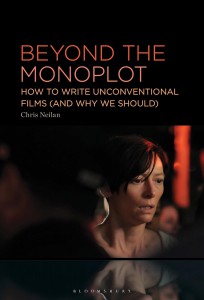
Beyond the Monoplot
How to Write Unconventional Films (and Why We Should)
de Chris Neilan


 (0 vote)
Moyenne des votes :
| 0 | vote |  = On peut s'en passer = On peut s'en passer |
| 0 | vote |  = Bon livre = Bon livre |
| 0 | vote |  = Excellent livre = Excellent livre |
| 0 | vote |  = Unique / une référence = Unique / une référence |
Votre vote : -
Description de l'ouvrage:
This book provides a toolkit for unconventional practice—a comprehensive list of unconventional story shapes and the meanings they create, with accompanying case studies, including: one-act structure; two-act structure; passive protagonists; untimely death of the protagonist, and more. Formed from Aristotelian principles and a three-act shape brought to Hollywood by Broadway playwrights after the advent of sync sound, Conventional Monoplot has come to dominate screen storytelling practice throughout the Western world. For the experimental, rule-suspicious, unconventional screenwriter, alternative storytelling models are available. Beyond the Monoplot offers screenwriters and screenwriting students a new way of approaching and quantifying conventional practice, whilst equipping them with the skills and tools to subvert convention and expectation in dynamic and innovative ways. Where the revolutionary New Hollywood period of the ‘60s and ‘70s saw strikingly iconoclastic, original, rule-breaking narratives attracting enormous audiences and making indelible cultural imprints, today’s most widely seen films stick rigidly to the Conventional Monoplot model. Shaped and solidified by best-selling screenwriting handbooks of the ‘80s and 90s, this model proved incredibly useful for a rapidly industrialising consumerist approach to screen entertainment, pushing unconventional and innovative storytelling practices to the cultural fringe. Whilst bold, daring films are still made, their impact is muted: Moonlight, despite winning Best Picture, was only the 92nd highest grossing film of its year. And whilst great strides are made towards diversity and representation, story shapes remain cloistered within a consumerist and highly conventionalised form, against which this book pushes back.
À propos de l'auteur :
Chris Neilan is Lecturer in Screenwriting & Development at Edinburgh Napier University, UK. He is an author, screenwriter and filmmaker currently finishing his PhD in Creative Writing and teaching screenwriting at Edinburgh Napier University, UK. He has won and been nominated for several international awards for films and short fiction. He is the author of a hybrid novel, Stellify (2022).
Revue de Presse:
"A cogent and scholarly analysis, Beyond the Monoplot argues that since the '80s and '90s the linear, chronological, one-hero Hollywood story model has come to dominate both theory and practice of screenwriting, resulting in a serious drop in quality, originality and experimentation. Provocative and thought-provoking, Chris Neilan vigorously interrogates the received wisdom and sets out a range of structural alternatives to the Hollywood template. A striking new voice in the study of screenwriting." ―Linda Aronson, Writer, Author of The 21st Century Screenplay, Australia
"Chris Neilan has provided a meticulously researched and highly readable wrecking ball aimed directly at the flawed, creativity-deadening screenwriting models that have dominated screenwriting discourse and practice for more than forty years. He connects a catastrophic decline in the quality of American films starting in 1980 to changes in the corporate structure of the studios, reinforced by the concurrent popularity of screenwriting manuals that have served more to enrich their authors than to provide genuine insight into the craft. Having demolished these popular theories, Professor Neilan goes on to explore alternative models in detailed and insightful analyses, providing mind-opening inspiration for creatives yearning to be free of the stultifying encumbrances of fashionable convention. " ―Paul Joseph Gulino, Professor, Chapman University, USA
> Sur un thème proche :
The Heart of Your Script (2026)
The Insider's Guide to Writing the Difficult Middle Section of a Screenplay
de Ted Wilkes et Phil Hughes
Sujet : Technique > Scriptwriting
Games Directors Play (2026)
Tricks and Stratagems of Cinematic Storytelling
Sujet : Technique > Scriptwriting
Integrated Storytelling by Design (2026)
Concepts, Principles and Methods for New Narrative Dimensions
Sujet : Technique > Scriptwriting
Rem Koolhaas as Scriptwriter (2025)
OMA Architecture Script for West Berlin
Sujet : Technique > Scriptwriting
Crafting Short Screenplays That Connect (2025)
Sujet : Technique > Scriptwriting
Scriptnotes (2025)
A Book About Screenwriting and Things That Are Interesting to Screenwriters
de John August et Craig Mazin
Sujet : Technique > Scriptwriting
Save the Cat! Writes Horror (2025)
The Ultimate Guide to Creating Monster in the House Stories
de Jamie Nash
Sujet : Technique > Scriptwriting
 Retour

