


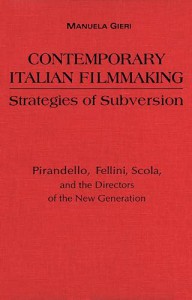
Contemporary Italian Filmmaking
Strategies of Subversion : Pirandello, Fellini, Scola, and the Directors of the New Generation


 (0 vote)
Moyenne des votes :
| 0 | vote |  = On peut s'en passer = On peut s'en passer |
| 0 | vote |  = Bon livre = Bon livre |
| 0 | vote |  = Excellent livre = Excellent livre |
| 0 | vote |  = Unique / une référence = Unique / une référence |
Votre vote : -
Description de l'ouvrage:
Contemporary Italian Filmmaking is an innovative critique of Italian filmmaking in the aftermath of World War II - as it moves beyond traditional categories such as genre film and auteur cinema. Manuela Gieri demonstrates that Luigi Pirandello's revolutionary concept of humour was integral to the development of a counter-tradition in Italian filmmaking that she defines `humoristic'. She delineates a `Pirandellian genealogy' in Italian cinema, literature, and culture through her examination of the works of Federico Fellini, Ettore Scola, and many directors of the `new generation,' such as Nanni Moretti, Gabriele Salvatores, Maurizio Nichetti, and Giuseppe Tornatore.
A celebrated figure of the theatrical world, Luigi Pirandello (1867-1936) is little known beyond Italy for his critical and theoretical writings on cinema and for his screenplays. Gieri brings to her reading of Pirandello's work the critical parameters offered by psychoanalysis, poststructuralism, and postmodernism to develop a syncretic and transcultural vision of the history of Italian cinema. She identifies two fundamental trends of development in this tradition: the `melodramatic imagination' and the `humoristic,' or comic, imagination. With her focus on the humoristic imagination, Gieri describes a `Pirandellian mode' derived from his revolutionary utterances on the cinema and narrative, and specifically, from his essay on humour, L'umorismo (On Humour, 1908). She traces a history of the Pirandellian mode in cinema and investigates its characteristics, demonstrating the original nature of Italian filmmaking that is particularly indebted to Pirandello's interpretation of humour.
Voir le site internet de l'éditeur University of Toronto Press
> Du même auteur :
> Sur un thème proche :
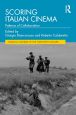
Scoring Italian Cinema (2025)
Patterns of Collaboration
Screening Religions in Italy (2019)
Contemporary Italian Cinema and Television in the Post-Secular Public Sphere
Dreamscapes in Italian Cinema (2019)
Dir. Francesco Pascuzzi et Bryan Cracchiolo
Masculinity and Italian Cinema (2014)
Sexual Politics, Social Conflict and Male Crisis in the 1970s
 Retour