

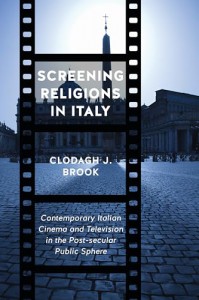
Screening Religions in Italy
Contemporary Italian Cinema and Television in the Post-Secular Public Sphere


 (0 vote)
Moyenne des votes :
| 0 | vote |  = On peut s'en passer = On peut s'en passer |
| 0 | vote |  = Bon livre = Bon livre |
| 0 | vote |  = Excellent livre = Excellent livre |
| 0 | vote |  = Unique / une référence = Unique / une référence |
Votre vote : -
Description de l'ouvrage:
Religion has had been foundational in shaping Italy. Home to the Vatican State, the Italian peninsula is the religious centre for one billion Catholics globally. It is also increasingly home to those of other faiths, especially Islam. Italy’s development as a contemporary post-secular and multi-religious society is fraught and fascinating.
The recent resurgence of religious discourse is a sign of what German philosopher, Jürgen Habermas, has defined as the post-secular condition. Habermas and others have questioned what most people in the West had, up to a few years ago, taken for granted: the unstoppable forward march of secularization and the subsequent marginalization of religion. Instead, one of the greatest global fault-lines in the contemporary world – the divide between absolutist, extremist Islamic faith and liberal, but Christian-inflected, secular values – has religious identity at its core. The first book-length study to examine religion in contemporary Italian cinema and television, Screening Religions in Italy spans genres such as horror, comedy, hagiopics, and TV fiction, and explores both commercial and art-house filmmaking. In a discussion of films and television series that range from Moretti’s Habemus Papam to Sorrentino’s The Young Pope, the author identifies two key issues: how Italian filmmaking constructs the continuing position of religion in the public sphere and why religion persists on Italian screens.
Voir le site internet de l'éditeur University of Toronto Press
> Du même auteur :
> Sur un thème proche :
Scoring Italian Cinema (2025)
Patterns of Collaboration
Dreamscapes in Italian Cinema (2019)
Dir. Francesco Pascuzzi et Bryan Cracchiolo
Masculinity and Italian Cinema (2014)
Sexual Politics, Social Conflict and Male Crisis in the 1970s
The Transatlantic Gaze (2014)
Italian Cinema, American Film
Brutal Vision (2012)
The Neorealist Body in Postwar Italian Cinema
Cinema Italiano (2011)
The Complete Guide from Classics to Cult
 Retour

