


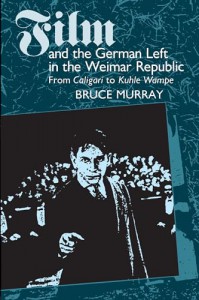
Film and the German Left in the Weimar Republic
From Caligari to Kuhle Wampe
de Bruce Murray


 (0 vote)
Moyenne des votes :
| 0 | vote |  = On peut s'en passer = On peut s'en passer |
| 0 | vote |  = Bon livre = Bon livre |
| 0 | vote |  = Excellent livre = Excellent livre |
| 0 | vote |  = Unique / une référence = Unique / une référence |
Votre vote : -
Description de l'ouvrage:
The Weimar Republic of Germany, covering the post-World War I period of civil and governmental strife, witnessed a great struggle among a variety of ideologies, a struggle for which the arts provided one important arena. Leftist individuals and organizations critiqued mainstream art production and attempted to counter what they perceived as its conservative-to-reactionary influence on public opinion. In this groundbreaking study, Bruce Murray focuses on the leftist counter-current in Weimar cinema, offering an alternative critical approach to the traditional one of close readings of the classical films.
Beginning with a brief review of pre-Weimar cinema (1896-1918), he analyzes the film activity of the Social Democratic Party, the German Communists, and independent leftists in the Weimar era. Leftist filmmakers, journalists, and commentators, who in many cases contributed significantly to marginal leftist as well as mainstream cinema, have, until now, received little scholarly attention. Drawing on exhaustive archival research and personal interviews, Murray shows how the plurality of aesthetic models represented in the work of individuals who participated in leftist experiments with cinema in the 1920S collapsed as Germany underwent the transition from parliamentary democracy to fascist dictatorship. He suggests that leftists shared responsibility for that collapse and asserts the value of such insights for those who contemplate alternatives to institutional forms of cinematic discourse today.
À propos de l'auteur :
Bruce Murray is a professor of German studies and global studies at the University of Illinois Urbana-Champaign.
Voir le site internet de l'éditeur University of Texas Press
> Sur un thème proche :

Weimar Cinema and After (2000)
Germany's Historical Imaginary


The Use and Abuse of Cinema (2015)
German Legacies from the Weimar Era to the Present
Sujet : History of Cinema

Film Societies in Germany and Austria 1910-1933 (2023)
Tracing the Social Life of Cinema

The Hygienic Apparatus (2022)
Weimar Cinema and Environmental Disorder
The Long Century's Long Shadow (2021)
Weimar Cinema and the Romantic Modern
Weimar Cinema, Embodiment, and Historicity (2019)
Cultural Memory and the Historical Films of Ernst Lubitsch
 Retour