


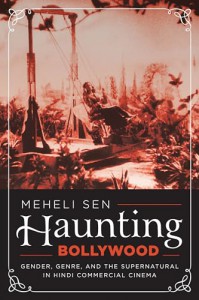
Haunting Bollywood
Gender, Genre, and the Supernatural in Hindi Commercial Cinema
by Meheli Sen


 (0 vote)
Average rating:
| 0 | rating |  = We can do without = We can do without |
| 0 | rating |  = Good book = Good book |
| 0 | rating |  = Excellent book = Excellent book |
| 0 | rating |  = Unique / a reference = Unique / a reference |
Your rating: -
Book Presentation:
Haunting Bollywood is a pioneering, interdisciplinary inquiry into the supernatural in Hindi cinema that draws from literary criticism, postcolonial studies, queer theory, history, and cultural studies. Hindi commercial cinema has been invested in the supernatural since its earliest days, but only a small segment of these films have been adequately explored in scholarly work; this book addresses this gap by focusing on some of Hindi cinema’s least explored genres.
From Gothic ghost films of the 1950s to snake films of the 1970s and 1980s to today’s globally influenced zombie and vampire films, Meheli Sen delves into what the supernatural is and the varied modalities through which it raises questions of film form, history, modernity, and gender in South Asian public cultures. Arguing that the supernatural is dispersed among multiple genres and constantly in conversation with global cinematic forms, she demonstrates that it is an especially malleable impulse that routinely pushes Hindi film into new formal and stylistic territories. Sen also argues that gender is a particularly accommodating stage on which the supernatural rehearses its most basic compulsions; thus, the interface between gender and genre provides an exceptionally productive lens into Hindi cinema’s negotiation of the modern and the global. Haunting Bollywood reveals that the supernatural’s unruly energies continually resist containment, even as they partake of and sometimes subvert Hindi cinema’s most enduring pleasures, from songs and stars to myth and melodrama.
> On a related topic:

The Neoliberal Self in Bollywood (2025)
Cinema, Popular Culture, and Identity
Muslim Identity in Hindi Cinema (2025)
Poetics and Politics of Genre and Representation
Déjà Viewed (2025)
Nation, Gender, and Genre in Bollywood Remakes of Hollywood Cinema
Centring Women in Bollywood Biopics (2024)
Empowerment and Agency in Contemporary Indian Cinema
Postcolonial Bollywood and Muslim Identity (2024)
Production, Representation, and Reception
Hindi Cinema and Pakistan (2024)
Screening the Idea and the Reality

 Back
Back

