

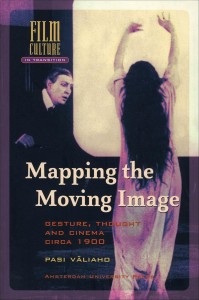
Mapping the Moving Image
Gesture, Thought and Cinema circa 1900
de Pasi Väliaho


 (0 vote)
Moyenne des votes :
| 0 | vote |  = On peut s'en passer = On peut s'en passer |
| 0 | vote |  = Bon livre = Bon livre |
| 0 | vote |  = Excellent livre = Excellent livre |
| 0 | vote |  = Unique / une référence = Unique / une référence |
Votre vote : -
Description de l'ouvrage:
In Mapping the Moving Image, Pasi Väliaho offers a compelling study of how the medium of film came to shape our experience and thinking of the world and ourselves. By locating the moving image in new ways of seeing and saying as manifest in the arts, science and philosophy at the turn of the twentieth century, the book redefines the cinema as one of the most important anthropological processes of modernity. Moving beyond the typical understanding of cinema based on optical and linguistic models, Mapping the Moving Image takes the notion of rhythm as its cue in conceptualizing the medium’s morphogenetic potentialities to generate affectivity, behaviour, and logics of sense. It provides a clear picture of how the forms of early film, while mobilizing bodily gestures and demanding intimate, affective engagement from the viewer, emerged in relation to bio-political investments in the body. The book also charts from a fresh perspective how the new gestural dynamics and visuality of the moving image fed into our thinking of time, memory and the unconscious.
À propos de l'auteur :
Pasi Väliaho is lecturer in film and screen studies at Goldsmiths College, University of London.
Revue de Presse:
"A commanding and consummate study of art, philosophy, the human sciences, physics, and biology in the matrix of cinema at the turn of the twentieth century. Blending contemporary theory with close readings of the foundational writings of modernity, Väliaho shows how the autonomy of the movie-machine shapes the ways we believe we think and live today. It will be a point of reference for every student of cinema, consciousness, and perception." -- Tom Conley, Harvard University
Voir le site internet de l'éditeur Amsterdam University Press
> Sur un thème proche :
Screens and Illusionism (2024)
Alternative Teleologies of Mediation
Dir. Peter Bloom et Dominique Jullien
Sujet : Theory
The Prison of Time (2024)
Stanley Kubrick, Adrian Lyne, Michael Bay and Quentin Tarantino
Sujet : Theory
Deep Mediations (2021)
Thinking Space in Cinema and Digital Cultures
Dir. Karen Redrobe et Jeff Scheible
Sujet : Theory
 Retour

