


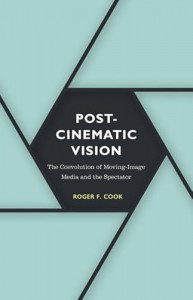
Postcinematic Vision
The Coevolution of Moving-Image Media and the Spectator


 (0 vote)
Average rating:
| 0 | rating |  = We can do without = We can do without |
| 0 | rating |  = Good book = Good book |
| 0 | rating |  = Excellent book = Excellent book |
| 0 | rating |  = Unique / a reference = Unique / a reference |
Your rating: -
Book Presentation:
A study of how film has continually intervened in our sense of perception, with far-ranging insights into the current state of lived experience
How has cinema transformed our senses, and how does it continue to do so? Positing film as a stage in the long coevolution of human consciousness and visual technology, Postcinematic Vision offer a fresh perspective on the history of film while providing startling new insights into the so-called divide between cinematic and digital media.
Starting with the argument that film viewing has long altered neural circuitry in our brains, Roger F. Cook proceeds to reevaluate film’s origins, as well as its merger with digital imaging in the 1990s. His animating argument is that film has continually altered the relation between media and human perception, challenging the visual nature of modern culture in favor of a more unified, pan-sensual way of perceiving. Through this approach, he makes original contributions to our understanding of how mediation is altering lived experience.
Along the way, Cook provides important reevaluations of well-known figures such as Franz Kafka, closely reading cinematic passages in the great author’s work; he reassesses the conventional wisdom that Marshall McLuhan was a technological determinist; and he lodges an original new reading of The Matrix. Full of provocative and far-reaching ideas, Postcinematic Vision is a powerful work that helps us see old concepts anew while providing new ideas for future investigation.
About the Author:
Roger F. Cook is professor of German studies and director of the Film Studies Program at the University of Missouri. He has written extensively on film and media theory, New German Cinema, and contemporary German film. He coedited The Cinema of Wim Wenders: Image, Narrative, and the Postmodern Condition and is coeditor of Berlin School Glossary: An ABC of the New Wave in German Cinema.
Press Reviews:
"Roger F. Cook’s groundbreaking book, Postcinematic Vision, is an original and intriguing contribution to the analysis of the emergence of cinematic technologies on the spectator. The analysis of changes in our perception in concert with changes in the history of film and post-filmic development is exigent for our time. Postcinematic Vision traces out a dialectical relationship between technologies and formal developments in film and changes in our experience of the body and its perceptual capacities, helping us take stock of where we stand today and what we stand against."—Todd McGowan, author of Emancipation After Hegel: Achieving a Contradictory Revolution
"Interrogating the cinema’s historical intermediality with rare clarity, Roger F. Cook claims that film’s historical transformations of perception and sensation in the early twentieth century still fundamentally shape the phenomenology of digital media—not to mention the sensoria of its users. Along the way, he engages with key critics from Marshall McLuhan and Friedrich Kittler to Anne Friedberg, Lev Manovich, and David Rodowick, challenging and revising their findings via compelling film readings and astute deployment of discourses as diverse as cybernetics and post-Romantic theories of writing. Postcinematic Vision is a compelling and singular work on living with twenty-first century media."—Paul Young, Dartmouth College
> From the same author:
Berlin School Glossary (2013)
An ABC of the New Wave in German Cinema
by Roger F. Cook, Lutz Koepnick, Kristin Kopp and Brad Prager
The Cinema of Wim Wenders (1997)
Image, Narrative and the Postmodern Condition
Dir. Roger F. Cook and Gerd Gemünden
Subject: Director > Wim Wenders
> On a related topic:
Screens and Illusionism (2024)
Alternative Teleologies of Mediation
Dir. Peter Bloom and Dominique Jullien
Subject: Theory
The Prison of Time (2024)
Stanley Kubrick, Adrian Lyne, Michael Bay and Quentin Tarantino
Subject: Theory
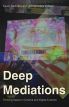
Deep Mediations (2021)
Thinking Space in Cinema and Digital Cultures
Dir. Karen Redrobe and Jeff Scheible
Subject: Theory
 Back
Back

