


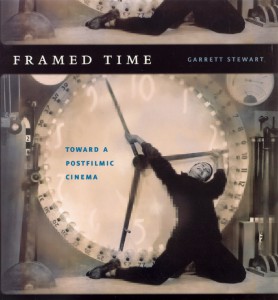
Framed Time
Toward a Postfilmic Cinema


 (0 vote)
Average rating:
| 0 | rating |  = We can do without = We can do without |
| 0 | rating |  = Good book = Good book |
| 0 | rating |  = Excellent book = Excellent book |
| 0 | rating |  = Unique / a reference = Unique / a reference |
Your rating: -
Book Presentation:
Italian director Michelangelo Antonioni claimed, three decades ago, that different conceptions of time helped define the split in film between European humanism and American science fiction. And as Garrett Stewart argues here, this transatlantic division has persisted since cinema’s 1995 centenary, made more complex by the digital technology that has detached movies from their dependence on the sequential frames of the celluloid strip.
Brilliantly interpreting dozens of recent films—from Being John Malkovich, Donnie Darko, and The Sixth Sense to La mala educación and Caché —Stewart investigates how their treatments of time reflect the change in media from film’s original rolling reel to today’s digital pixel. He goes on to show—with 140 stills—how American and European narratives confront this shift differently: while Hollywood movies tend to revolve around ghostly afterlives, psychotic doubles, or violent time travel, their European counterparts more often feature second sight, erotic telepathy, or spectral memory. Stewart questions why these recent plots, in exploring temporality, gravitate toward either supernatural or uncanny apparitions rather than themes of digital simulation. In doing so, he provocatively continues the project he began with Between Film and Screen, breaking new ground in visual studies, cinema history, and media theory.
Press Reviews:
“Garrett Stewart’s unique sensibility—which combines textual perception with a vigilant receptivity for variations in technology—here affords us rich insights into the ‘time image’ and in particular into the relationship between plot-formation and the digital. This is wonderful reading and thinking!”
Fredric Jameson
“In this remarkable book, Garrett Stewart demonstrates convincingly that the encounter between the cinematic and the digital has produced a body of films that are emblematic of hybridity, confused temporality, and diminished narrative coherence and control. Stewart’s innovative and imaginative concept of ‘narratography’ draws attention to those points at which both narrative and technological uncertainty erupt symptomatically into image and idea on the screen.”
Laura Mulvey, Birkbeck College, University of London
“Imagining a retrospective glance from deeper into our new millennium, future scholars of the moving image may come to recognize Garrett Stewart’s Framed Time as provoking a decisive turning point. The object of theory no longer appears between film and screen, but rather between frame and pixel. In this exciting book, Stewart brilliantly pictures the transition where film has disappeared from American and European screens, while cinema has become something else—the expression of digitime as a new consciousness in and of images. The wild variety of how cinema imagines its new virtual life in the Silicon Era is vividly on display in this path-breaking book.”
D. N. Rodowick, Harvard University
“In Framed Time Garrett Stewart applies a narratographic method to map the as yet incomplete transition from a filmic cinema timed by the moving frame to a digital cinema that ‘frames time in its change,’ from imprinted track to transformative array. In startling engagements with individual films Stewart analyzes the various means by which contemporary film narrates its own slow dying and figures what it may become. Audacious and convincing, Framed Time is exhilarating criticism.”
Jerome Christensen, University of California, Irvine
"Framed Time remains compelling both as a study in a particular way of reading that may yet become influential, and a study of what cinema itself is becoming."
Mike Lim | Screening the Past
"An enjoyable and thought-provoking read thanks to its ambition and wide scope. By grounding an otherwise theoretical work in genuine . . . film analysis, Stewart also aims for the development of a bottom-up theory based upon a body of films."
William Brown | New review of Film and Television Studies
> From the same author:

> On a related topic:
Radical Embodiment on Film (2026)
Time and the Cinematic Body
Dir. Louis Bayman and Davina Quinlivan
Subject: Theory
The Prison of Time (2024)
Stanley Kubrick, Adrian Lyne, Michael Bay and Quentin Tarantino
Subject: Theory
Time, Existential Presence and the Cinematic Image (2018)
Ethics and Emergence to Being in Film
Subject: Theory
Temporality in American Filmic Autobiography (2018)
Cinema, Automediality and Grammatology with 'film Portrait' and 'joyce at 34'
Subject: Theory
 Back
Back

