

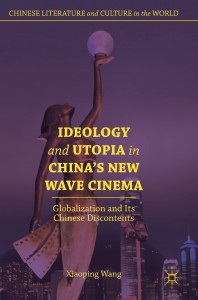
Ideology and Utopia in China's New Wave Cinema
Globalization and Its Chinese Discontents


 (0 vote)
Average rating:
| 0 | rating |  = We can do without = We can do without |
| 0 | rating |  = Good book = Good book |
| 0 | rating |  = Excellent book = Excellent book |
| 0 | rating |  = Unique / a reference = Unique / a reference |
Your rating: -
Book Presentation:
Ideology and Utopia in China’s New Wave Cinema investigates the ways in which New Wave filmmakers represent China in this age of neoliberal reform. Analyzing this paradigm shift in independent cinema, this text explores the historicity of the cinematic form and its cultural-political visions. Through a close reading of the narrative strategy of key films in New Wave Cinema, Xiaoping Wang studies the movement’s impact on film, literature, culture and politics.
About the Author:
XiaopingWang is Chair Professor of Chinese Studies at Huaqiao University, China. He has published more than 100 research articles on modern and contemporary Chinese literature, culture and critical theory.
Press Reviews:
"With Ideology and Utopia in China’s New Wave Cinema, Xiaoping Wang offers a nuanced and ground-breaking examination of the collective known as the Sixth Generation and their remarkable films. By positioning this body of work within the context of globalization, Wang peels away the complex layers of social questions that filmmakers like Wang Xiaoshuai and Jia Zhangke have engaged with, while offering fresh new insights into the cultural field in contemporary China." (Michael Berry, Professor of Contemporary Chinese Cultural Studies, UCLA, USA, and author of Jia Zhangke’s Hometown Trilogy, 2009)
"In this outstanding and original study, Xiaoping Wang examines many of the Chinese films celebrated in the West in recent decades, giving readers a deeper understanding of their social contexts and effects. Challenging the common view of scholars and critics who celebrate this cinema as politically subversive, he offers a trenchant Marxist critique of the ways these films, despitetheir apparent style of social realism, ultimately are complicit in the bourgeois neoliberalism that has extended its global reach into China." (Jason McGrath, Associate Professor of Asian Languages & Literatures and Moving Image & Media Studies at the University of Minnesota - Twin Cities, USA, and the author of Postsocialist Modernity: Chinese Cinema, Literature, and Criticism in the Market Age, 2008)
> From the same author:
China in the Age of Global Capitalism (2021)
Jia Zhangke's Filmic World
Subject: Director > Jia Zhang-ke
> On a related topic:
Romanian and Chinese Cinemas (2025)
Socialist Affect and Cultural Politics from Maoism to the New Waves
by Lucian Țion
Working the System (2023)
Motion Picture, Filmmakers, and Subjectivities in Mao-Era China, 1949–1966
by Qiliang He
Urban Horror (2020)
Neoliberal Post-Socialism and the Limits of Visibility
The Politics of Memory in Sinophone Cinemas and Image Culture (2019)
Altering Archives
Dir. Peng Hsiao-yen and Ella Raidel
Art, Politics, and Commerce in Chinese Cinema (2010)
Dir. Ying Zhu and Stanley Rosen
 Back
Back