

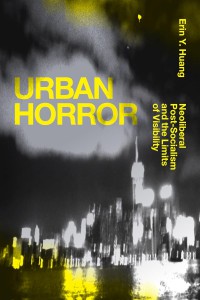
Urban Horror
Neoliberal Post-Socialism and the Limits of Visibility


 (0 vote)
Moyenne des votes :
| 0 | vote |  = On peut s'en passer = On peut s'en passer |
| 0 | vote |  = Bon livre = Bon livre |
| 0 | vote |  = Excellent livre = Excellent livre |
| 0 | vote |  = Unique / une référence = Unique / une référence |
Votre vote : -
Description de l'ouvrage:
In Urban Horror Erin Y. Huang theorizes the economic, cultural, and political conditions of neoliberal post-socialist China. Drawing on Marxist phenomenology, geography, and aesthetics from Engels and Merleau-Ponty to Lefebvre and Rancière, Huang traces the emergence and mediation of what she calls urban horror—a sociopolitical public affect that exceeds comprehension and provides the grounds for possible future revolutionary dissent. She shows how documentaries, blockbuster feature films, and video art from China, Hong Kong, and Taiwan made between the 1990s and the present rehearse and communicate urban horror. In these films urban horror circulates through myriad urban spaces characterized by the creation of speculative crises, shifting temporalities, and dystopic environments inhospitable to the human body. The cinematic image and the aesthetics of urban horror in neoliberal post-socialist China lay the groundwork for the future to such an extent, Huang contends, that the seeds of dissent at the heart of urban horror make it possible to imagine new forms of resistance.
À propos de l'auteur :
Erin Y. Huang is Assistant Professor of East Asian Studies and Comparative Literature at Princeton University.
Revue de Presse:
"What is ‘horror’ in the contemporary world? With reference to numerous interesting Chinese-language films, Erin Y. Huang argues that horror is a morphing assemblage of sociohistorical forces, one that creates a disjuncture between a perceived external reality and an internal frame of comprehension. An admirably timely statement on the often hypermedial—and horrific—performativity of urban public sentiments, in post-socialist China as in EuroAmerica and beyond."―Rey Chow, author of, Sentimental Fabulations, Contemporary Chinese Films: Attachment in the Age of Global Visibility
"In this visionary book Erin Y. Huang lays out a new epistemology of the political, cultural, and affective present while gesturing toward desirable futures. This book will galvanize the study of Chinese cinema and interdisciplinary studies of the urban; it will be of unique interest to all those across the humanities who are striving to decipher the logics of the global, neoliberal present. Like no other book, Urban Horror makes the affective, political, and material contours of the contemporary Asian city available to social theory. A vitally innovative work."―Arnika Fuhrmann, author of, Ghostly Desires: Queer Sexuality and Vernacular Buddhism in Contemporary Thai Cinema
"What makes Urban Horror particularly valuable is Huang’s attention to historical and cultural specificity in her application of Western theories. For example, in her discussion of Li Shaohong’s films, she avoids taking feminism as a transhistorical and universal category. Rather, she excavates the nuanced and complex meanings of Chinese femininity to theorize postsocialist feminism within the context of modern and socialist Chinese history…. Huang’s theoretical approach is an excellent model for contextualizing Western theories and philosophies for Asian studies."―Li Zeng, Film Quarterly
"Huang’s close reading of films and theoretical texts is lucid and persuasive.... Urban Horror is suitable not only for readers who are interested in understanding the post-socialist condition in China but also those who are generally drawn to the long-standing academic tradition of theorizing the relationship between aesthetics and politics...."―Ziwei Chen, Asiascape
"Few books can be timelier than Erin Y. Huang’s erudite and insightful Urban Horror.... Huang could not have foreseen the emergence of COVID-19 when writing, but it has certainly amplified the resonance of her work."―Chris Berry, The China Journal
"Huang’s study is impressive in her sophisticated theoretical analysis and innovative textual readings. I highly recommend [Urban Horror] to scholars and students in the fields of contemporary Chinese or Sinophone studies, film and media studies, urban studies, as well as studies of affect and sensuality."―Yu Zhang, Journal of Asian Studies
"Urban Horror is a sprawling, complex, and challenging book, full of acute theoretical insights and detailed close readings of narrative and documentary films. . . . [It] is a powerful and timely piece of speculative theory and film criticism, a pressing read for scholars of modern and contemporary China, film and media studies, and the study of postsocialist culture."―Hongwei Thorn Chen, MCLC Resource Center
"Urban Horror provides a fascinating read especially for those interested in bringing together economic and cultural histories of the recent past. . . . Urban Horror is an indispensable read for any historian trying to get a grasp of the relation between popular culture and public sentiment in the neoliberal era."―Dennis Koelling, European Review of History
> Sur un thème proche :
Painting the City Red (2010)
Chinese Cinema and the Urban Contract

Ethnic Minority Children in Post-Socialist Chinese Cinema (2021)
Allegory, Identity, and Geography
de Zhenhui Yan
 Retour