

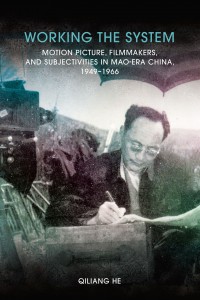
Working the System
Motion Picture, Filmmakers, and Subjectivities in Mao-Era China, 1949–1966
by Qiliang He


 (0 vote)
Average rating:
| 0 | rating |  = We can do without = We can do without |
| 0 | rating |  = Good book = Good book |
| 0 | rating |  = Excellent book = Excellent book |
| 0 | rating |  = Unique / a reference = Unique / a reference |
Your rating: -
Book Presentation:
An examination of five Shanghai-based filmmakers under Mao's sociopolitical system.
In Working the System, Qiliang He inquires into the making of the new citizenry in Mao-era China by studying five preeminent Shanghai-based filmmakers. These case studies shed light on how individuals’ subjectivities took shape in the cinematic arena under a new sociopolitical system after 1949. He suggests that a filmmaker’s subjectivity was not fixed or stable but constantly in flux, requiring a host of “subjectivizing practices” to (re)shape and consolidate it. These filmmakers endeavored to reap maximal benefits from Mao’s sociopolitical system and minimize the disadvantages that would make them victims under the system. In short, Qiliang He argues that the filmmakers not only worked under the socialist system imposed upon them but also worked the system in their best interests.
Press Reviews:
"This is a well-researched study of five Shanghai-based filmmakers during Mao's China. It will be of interest to scholars and students of Chinese film history, modern Chinese history and the Cold War."
The China Quarterly
“Through five chosen filmmakers’ creative control and their negotiation of their professional status within China’s newly adopted socialist system, the author presents a compelling case that illustrates how individual filmmakers constantly adjusted themselves professionally and ideologically to survive in a fast-changing industry and a highly politicized society.”
Lin Feng, University of Leicester
“This book is a strong example of how much more we can learn about Mao-era Chinese culture if we approach it less as alien due to Cold War prejudices and instead think of artists as creating under professional constraints in China just as they do everywhere.”
Jason McGrath, University of Minnesota
> On a related topic:
Chinese Cinema (2023)
Identity, Power, and Globalization
Dir. Jeff Kyong-McClain, Russell Meeuf and Jing Jing Chang

Party Hegemony and Entrepreneurial Power in China (2015)
Institutional Change in the Film and Music Industries
From May Fourth to June Fourth (1993)
Fiction and Film in Twentieth-Century China
Dir. Ellen Widmer and David Der-wei Wang
Romanian and Chinese Cinemas (2025)
Socialist Affect and Cultural Politics from Maoism to the New Waves
by Lucian Țion
 Back
Back