


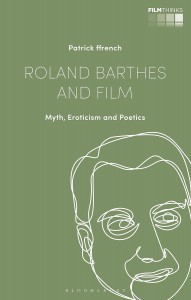
Roland Barthes and Film
Myth, Eroticism and Poetics


 (0 vote)
Average rating:
| 0 | rating |  = We can do without = We can do without |
| 0 | rating |  = Good book = Good book |
| 0 | rating |  = Excellent book = Excellent book |
| 0 | rating |  = Unique / a reference = Unique / a reference |
Your rating: -
Book Presentation:
Suspicious of what he called the spectator’s “sticky” adherence to the screen, Roland Barthes had a cautious attitude towards cinema. Falling into a hypnotic trance, the philosopher warned, an audience can become susceptible to ideology and “myth”. In this book, Patrick Ffrench explains that although Barthes was wary of film, he engaged deeply with it. Barthes’ thought was, Ffrench argues, punctuated by the experience of watching films – and likewise his philosophy of photography, culture, semiotics, ethics and theatricality have been immensely important in film theory. Focusing particularly on the essays ‘The Third Meaning’ and ‘On Leaving the Cinema’ and the acclaimed book Camera Lucida, Ffrench examines Barthes’ writing and traces a persistent interest in films and directors, from Fellini and Antonioni, to Eisenstein, the Marx Brothers and Hitchcock. Ffrench explains that although Barthes found pleasure in “leaving the cinema” – disconnecting from its dangerous allure by a literal exit or by forcefully breaking the trance – he found value in returning to the screen anew. Barthes delved beneath the pull of progressing narrative and the moving image by becoming attentive to space and material aesthetics. This book presents an invaluable reassessment of one of the most original and subtle thinkers of the twentieth-century: a figure indebted to the movies.
About the Author:
Lúcia Nagib is Professor of Film and Director of the Centre for Film Aesthetics and Cultures (CFAC) at the University of Reading. Her research has focused, among other subjects, on polycentric approaches to world cinema, new waves and new cinemas, cinematic realism and intermediality. She is the author of World Cinema and the Ethics of Realism (Continuum, 2011), Brazil on Screen: Cinema Novo, New Cinema, Utopia (I.B. Tauris, 2007), The Brazilian Film Revival: Interviews with 90 Filmmakers of the 90s (Editora 34, 2002), Born of the Ashes: The Auteur and the Individual in Oshima's Films (Edusp, 1995), Around the Japanese Nouvelle Vague (Editora da Unicamp, 1993) and Werner Herzog: Film as Reality (EstaçãoLiberdade, 1991). She is the editor of Impure Cinema: Intermedial and Intercultural Approaches to Film (with Anne Jerslev, 2013), Theorizing World Cinema (with Chris Perriam and Rajinder Dudrah, I.B. Tauris, 2011), Realism and the Audiovisual Media (with Cecília Mello, Palgrave, 2009), The New Brazilian Cinema (I.B. Tauris, 2003), Master Mizoguchi (Navegar, 1990) and Ozu (Marco Zero, 1990).
> From the same author:
> On a related topic:
Radical Embodiment on Film (2026)
Time and the Cinematic Body
Dir. Louis Bayman and Davina Quinlivan
Subject: Theory
Making Sense of Cinema (2017)
Empirical Studies into Film Spectators and Spectatorship
Dir. Carrielynn D. Reinhard and Christopher J. Olson
Subject: Theory
Beyond the Stars 2 (1991)
Plot Conventions in American Popular Film
Dir. Paul Loukides and Linda K. Fuller
Subject: Technique > Scriptwriting
Feminist Visions (2026)
Tracing Feminist Epistemologies in Contemporary Film and Television
Dir. Hélène Charlery and Cristelle Maury
Subject: Sociology
Unsuitable Film and Video Audiences (2026)
Underage Viewing Memories and Practices in 1980s United Kingdom
by Peter Turner
Subject: Sociology
Displacement of (M)others in Twenty-First-Century US Films (2026)
Impact on Maternal Identities of "Other" Subjectivities
Subject: Sociology
 Back
Back

