


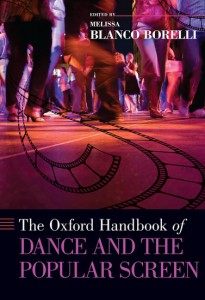
The Oxford Handbook of Dance and the Popular Screen
Edited by Melissa Blanco Borelli


 (0 vote)
Average rating:
| 0 | rating |  = We can do without = We can do without |
| 0 | rating |  = Good book = Good book |
| 0 | rating |  = Excellent book = Excellent book |
| 0 | rating |  = Unique / a reference = Unique / a reference |
Your rating: -
Book Presentation:
• Covers bodily movement as well as conventionally-defined dance
• Offers newly commissioned research
• Written in engaging and accessible language
• Truly interdisciplinary, drawing from dance studies, performance studies, and film and media studies
The Oxford Handbook of Dance and the Popular Screen sets the agenda for the study of dance in popular moving images - films, television shows, commercials, music videos, and YouTube - and offers new ways to understand the multi-layered meanings of the dancing body by engaging with methodologies from critical dance studies, performance studies, and film/media analysis. Through thorough engagement with these approaches, the chapters demonstrate how dance on the popular screen might be read and considered through bodies and choreographies in moving media.
Questions the contributors consider include: How do dance and choreography function within the filmic apparatus? What types of bodies are associated with specific dances and how does this affect how dance(s) is/are perceived in the everyday? How do the dancing bodies on screen negotiate power, access, and agency? How are multiple choreographies of identity (e.g., race, class, gender, sexuality, and nation) set in motion through the narrative, dancing bodies, and/or dance style? What types of corporeal labors (dance training, choreographic skill, rehearsal, the constructed notion of "natural talent") are represented or ignored? What role does a specific film have in the genealogy of Hollywood dance film? How does the Hollywood dance film inform how dance operates in making cultural meanings?
Whether looking at Bill "Bojangles" Robinson's tap steps in Stormy Weather, or Baby's leap into Johnny Castle's arms in Dirty Dancing, or even Neo's backwards bend in The Matrix, the book's arguments offer powerful new scholarship on dance in the popular screen.
About the Author:
Edited by Melissa Blanco Borelli, Senior Lecturer, Drama and Theatre, Royal Holloway University Melissa Blanco Borelli is Senior Lecturer in the Drama and Theatre Department at Royal Holloway, University of London. Previously she was Lecturer in Dance and Film Studies at the University of Surrey.
> On a related topic:
Gesture and Film (2020)
Signalling New Critical Perspectives
Dir. Nicholas Chare and Liz Watkins
Subject: Theory
Deleuze's Cinema Books (2016)
Three Introductions to the Taxonomy of Images
by David Deamer
Subject: Theory

Hip Hop on Film (2015)
Performance Culture, Urban Space, and Genre Transformation in the 1980s
Subject: Sociology
 Back
Back

