


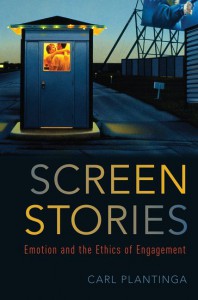
Screen Stories
Emotion and the Ethics of Engagement


 (0 vote)
Average rating:
| 0 | rating |  = We can do without = We can do without |
| 0 | rating |  = Good book = Good book |
| 0 | rating |  = Excellent book = Excellent book |
| 0 | rating |  = Unique / a reference = Unique / a reference |
Your rating: -
Book Presentation:
• Offers a new ethical theory of film and media studies
• Views communication as an extension of cultural ecology
• Provides a refreshingly accessible perspective on spectatorship
The way we communicate with each other is vital to preserving the cultural ecology, or wellbeing, of a place and time. Do we listen to each other? Do we ask the right questions? Do we speak about each other with respect or disdain? The stories that we convey on screens, or what author Carl Plantinga calls 'screen stories,' are one powerful and pervasive means by which we communicate with each other. Screen Stories: Emotion and the Ethics of Engagement argues that film and media studies needs to move toward an an approach to ethics that is more appropriate for mass consumer culture and the lives of its citizens.
Primarily concerned with the relationship between media and viewers, this book considers ethical criticism and the emotional power of screen stories that makes such criticism necessary. The content we consume—from television shows and movies to advertisements—can significantly affect our welfare on a personal and societal level, and thus, this content is subject to praise and celebration, or questioning and even condemnation. The types of screen stories that circulate contribute to the cultural ecology of a time and place; through shared attention they influence what individuals think and feel. Plantinga develops a theory of the power of screen stories to affect both individuals and cultures, asserting that we can better respond ethically to such media if we understand the sources of its influence on us.
About the Author:
Carl Plantinga, Professor of Film and Media, Calvin College Carl Plantinga is Professor of Film and Media at Calvin College. He is author or co-editor of five books on topics ranging from the documentary to the philosophy of film to the place of emotion in film viewing.
> From the same author:

The Routledge Companion to Philosophy and Film (2011)
Dir. Paisley Livingston and Carl Plantinga
Subject: Theory
Passionate Views (1999)
Film, Cognition, and Emotion
Dir. Carl Plantinga and Greg M. Smith
Subject: Sociology
> On a related topic:
Film and Television Production in the Age of Climate Crisis (2022)
Towards a Greener Screen
Dir. Pietari Kääpä and Hunter Vaughan
Subject: General
Think/Point/Shoot (2016)
Media Ethics, Technology and Global Change
Dir. Annette Danto, Mobina Hashmi and Lonnie Isabel
Subject: General
Ecological And Environmental Turns (2025)
(Re)mapping China's Sociocultural Landscape through Ecocinema
by Shuqin Cui
River Delta Futures (2026)
Endangered Communities in Audiovisual Media
Dir. Francisco-J. Hernández Adrián and Angelos Theocharis
Subject: Sociology


Elemental World Cinema (2025)
Cinematic Entanglements of Earth, Fire, Water and Air
Dir. Tiago de Luca and Matilda Mroz
Subject: Sociology
Negative Life (2024)
The Cinema of Extinction
by Steven Swarbrick and Jean-Thomas Tremblay
Subject: Sociology
 Back
Back

