


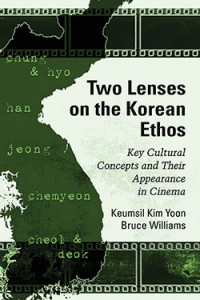
Two Lenses on the Korean Ethos
Key Cultural Concepts and Their Appearance in Cinema
by Keumsil Kim Yoon and Bruce Williams


 (0 vote)
Average rating:
| 0 | rating |  = We can do without = We can do without |
| 0 | rating |  = Good book = Good book |
| 0 | rating |  = Excellent book = Excellent book |
| 0 | rating |  = Unique / a reference = Unique / a reference |
Your rating: -
Book Presentation:
A war-torn country only 60 years ago, South Korea has since achieved prodigious growth and global integration, experiencing rapid industrialization and seeing its cultural exports gain international popularity. Because of this rapid transformation, an investigation of the Korean ethos—the shared self-concept woven through the divergent social contexts of both South and North Korea—is challenging. This book provides an introduction to the Korean ethos, detailing its representation in key cultural words and in film. Part I explores definitive concepts (terms) generally regarded as difficult to translate, such as han (regret), jeong (feeling) and deok (virtue), and how they are expressed in Korean cinema. Part II analyzes film narratives based on these concepts via close readings of 13 films, including three from North Korea.
About the authors:
Keumsil Kim Yoon is a professor of linguistics in the Department of Languages and Cultures at William Paterson University, Wayne, New Jersey. She has published widely in the areas of bilingualism, sociolinguistics and pragmatics.
Bruce Williams is a professor in the Department of Languages and Cultures at William Paterson University. He has published extensively in the areas of cinema history, film theory, and language and cinema.
> From the same authors:
Albanian Cinema Through the Fall of Communism (2023)
Silver Screens and Red Flags
> On a related topic:
South Korean Golden Age Melodrama (2000)
Gender, Genre, and National Cinema
Dir. Kathleen McHugh and Nancy Abelmann
The Late and Post-Dictatorship (2025)
Cinephilia Boom and Art Houses in South Korea
The Korean War and Postmemory Generation (2023)
Contemporary Korean Arts and Films
Movie Minorities (2021)
Transnational Rights Advocacy and South Korean Cinema

Movie Migrations (2015)
Transnational Genre Flows and South Korean Cinema
Pop Empires (2019)
Transnational and Diasporic Flows of India and Korea
Dir. S. Heijin Lee, Monika Mehta and Robert Ji-Song Ku

Nation, Culture and Class in Argentine Cinema (2020)
Crisis and Representation (1998-2005)

Framing the Nation (2011)
Languages of 'Modernity' in India
Japanese Cinema and Otherness (2011)
Nationalism, Multiculturalism and the Problem of Japaneseness
by Mika Ko
 Back
Back

