


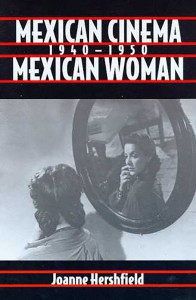
Mexican Cinema/Mexican Woman
1940-1950


 (0 vote)
Average rating:
| 0 | rating |  = We can do without = We can do without |
| 0 | rating |  = Good book = Good book |
| 0 | rating |  = Excellent book = Excellent book |
| 0 | rating |  = Unique / a reference = Unique / a reference |
Your rating: -
Book Presentation:
The female image has been an ambiguous one in Mexican culture, and the place of women in Mexican cinema is no less tenuous--yielding in the films of Luis Buñuel and others a range of characterizations from virgin to whore, mother to femme fatale. Mexican Cinema/Mexican Woman, 1940-1950 examines a singular moment in the history of Mexican film to investigate the ways in which the cinematic figures of woman functioned to mediate narrative and social debates. The book raises new questions about the relations between woman and cinema. It will have broad appeal among students and scholars of film, feminist studies, and Latin American studies, as well as those interested in the popular culture of Mexico. Considering the historical and cultural representations of sexual difference as well as race and class, Hershfield closely examines the portrayal of women and gender identity in six films: María Candelaria (Emilio Fernández, 1943), Río Escondido (Emilio Fernández, 1947), Distinto amanecer (Julio Bracho, 1943), Salón México (Emilio Fernández, 1948), Doña Bárbara (Fernando de Fuentes, 1943), and Susana (Carne y demonio) (Luis Buñuel, 1950).
About the Author:
Joanne Hershfield is an assistant professor of communication studies at the University of North Carolina at Chapel Hill. Her articles on Mexican cinema have been published in Wide Angle and The Spectator: A Journal of Film and Television.
> From the same author:

> On a related topic:
Adapting Gender (2019)
Mexican Feminisms from Literature to Film
Motherhood in Mexican Cinema, 1941–1991 (2013)
The Transformation of Femininity on Screen

Spectacle Every Day / Espectáculo a diario (2023)
Essays on classical Mexican cinema 1940-1969
Dir. Díaz de la Vega Alonso and Jorge Javier Negrete Camacho
(in English and Spanish)

Woman-Centered Brazilian Cinema (2023)
Filmmakers and Protagonists of the Twenty-First Century
Dir. Jack A. Draper III and Cacilda M. Rêgo
The Lost Cinema of Mexico (2022)
From Lucha Libre to Cine Familiar and Other Churros
Dir. Olivia Cosentino and Brian Price

The White Indians of Mexican Cinema (2022)
Racial Masquerade throughout the Golden Age
Mexico Unmanned (2022)
The Cultural Politics of Masculinity in Mexican Cinema
 Back
Back