


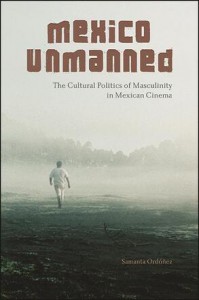
Mexico Unmanned
The Cultural Politics of Masculinity in Mexican Cinema


 (0 vote)
Average rating:
| 0 | rating |  = We can do without = We can do without |
| 0 | rating |  = Good book = Good book |
| 0 | rating |  = Excellent book = Excellent book |
| 0 | rating |  = Unique / a reference = Unique / a reference |
Your rating: -
Book Presentation:
Demonstrates how transhistorical myths of masculinity are both perpetuated and challenged in recent Mexican cinema.
Iconic images of machismo in Mexico's classic cinema affirm the national film industry's historical alignment with the patriarchal ideology intrinsic to the post-revolutionary state's political culture. Filmmakers gradually turned away from the cultural nationalism of mexicanidad, but has the underlying gender paradigm been similarly abandoned? Films made in the past two decades clearly reflect transformations instituted by a neoliberal regime of cultural politics, yet significant elements of macho mythology continue to be rearticulated. Mexico Unmanned examines these structural continuities in recent commercial and auteur films directed by Alfonso Cuarón, Carlos Cuarón, Carlos Reygadas, Amat Escalante, and Julio Hernández Cordón, among others. Informed by cinema's role in Mexico's modern/colonial gender system, Samanta Ordóñez draws out recurrent patterns of signification that reproduce racialized categories of masculinity and bolster a larger network of social hierarchies. In so doing, Ordóñez dialogues with current intersectional gender theory, fresh scholarship on violence in the neoliberal state, and the latest research on Mexican cinema.
About the Author:
Samanta Ordóñez is Assistant Professor of Spanish at Wake Forest University.
Press Reviews:
"Samanta Ordóñez offers a lucid critique of complex issues such as machismo, race, class and their representations in contemporary Mexican cinema … Ordóñez contributes to the study of masculinities by exposing the power structures that are constantly seeking control over the bodies of middle- and lower-class racialized men. Her analysis of malformed masculinities promotes the questioning of unfair, biased, or silenced representations of different minorities in Mexican cinema: another indicator of a defective modernity whose archetypal models have repeatedly failed to adequately represent Mexico or Latin America." — Bulletin of Spanish Visual Studies
See the publisher website: State University of New York Press
> On a related topic:
Cinemachismo (2006)
Masculinities And Sexuality in Mexican Film


Spectacle Every Day / Espectáculo a diario (2023)
Essays on classical Mexican cinema 1940-1969
Dir. Díaz de la Vega Alonso and Jorge Javier Negrete Camacho
(in English and Spanish)

Woman-Centered Brazilian Cinema (2023)
Filmmakers and Protagonists of the Twenty-First Century
Dir. Jack A. Draper III and Cacilda M. Rêgo

The Lost Cinema of Mexico (2022)
From Lucha Libre to Cine Familiar and Other Churros
Dir. Olivia Cosentino and Brian Price

The White Indians of Mexican Cinema (2022)
Racial Masquerade throughout the Golden Age



Tastemakers and Tastemaking (2021)
Mexico and Curated Screen Violence

 Back
Back

