


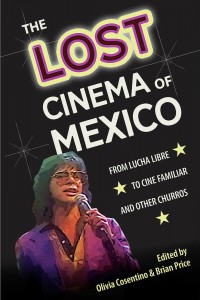
The Lost Cinema of Mexico
From Lucha Libre to Cine Familiar and Other Churros
Edited by Olivia Cosentino and Brian Price


 (0 vote)
Average rating:
| 0 | rating |  = We can do without = We can do without |
| 0 | rating |  = Good book = Good book |
| 0 | rating |  = Excellent book = Excellent book |
| 0 | rating |  = Unique / a reference = Unique / a reference |
Your rating: -
Book Presentation:
The Lost Cinema of Mexico is the first volume to challenge the dismissal of Mexican filmmaking during the 1960s through 1980s, an era long considered a low-budget departure from the artistic quality and international acclaim of the nation's earlier Golden Age. This pivotal collection examines the critical implications of discovering, uncovering, and recovering forgotten or ignored films.
This largely unexamined era of film reveals shifts in Mexican culture, economics, and societal norms as state-sponsored revolutionary nationalism faltered. During this time, movies were widely embraced by the public as a way to make sense of the rapidly changing realities and values connected to Mexico's modernization. These essays shine a light on many genres that thrived in these decades: rock churros, campy luchador movies, countercultural superocheros, Black melodramas, family films, and Chili Westerns.
Redefining a time usually seen as a cinematic "crisis," this volume offers a new model of the film auteur shaped by productive tension between highbrow aesthetics, industry shortages, and national audiences. It also traces connections from these Mexican films to Latinx, Latin American, and Hollywood cinema at large.
A volume in the series Reframing Media, Technology, and Culture in Latin/o America, edited by H ctor Fern ndez L'Hoeste and Juan Carlos Rodr guez
Contributors: Brian Price Carolyn Fornoff David S. Dalton Christopher B. Conway Iv n Eusebio Aguirre Darancou Ignacio S nchez Prado Dolores Tierney Dr. Olivia Cosentino
Publication of this work made possible by a Sustaining the Humanities through the American Rescue Plan grant from the National Endowment for the Humanities.
About the authors:
Olivia Cosentino is Zemurray-Stone Post-Doctoral Fellow at the Stone Center for Latin American Studies at Tulane University.
Brian Price is professor of Spanish at Brigham Young University. He is the author of Cult of Defeat in Mexico’s Historical Fiction: Failure, Trauma, and Loss and the editor of Asaltos a la historia: Reimaginando la ficción histórica hispanoamericana.
> From the same authors:

Classical Storytelling and Contemporary Screenwriting (2018)
Aristotle and the Modern Scriptwriter
by Brian Price
Subject: Technique > Scriptwriting
Neither God Nor Master (2011)
Robert Bresson and Radical Politics
by Brian Price
Subject: Director > Robert Bresson


Color, The Film Reader (2006)
Dir. Angela Dalle Vacche and Brian Price
Subject: Technique > Aesthetics
> On a related topic:



Spectacle Every Day / Espectáculo a diario (2023)
Essays on classical Mexican cinema 1940-1969
Dir. Díaz de la Vega Alonso and Jorge Javier Negrete Camacho
(in English and Spanish)

Woman-Centered Brazilian Cinema (2023)
Filmmakers and Protagonists of the Twenty-First Century
Dir. Jack A. Draper III and Cacilda M. Rêgo

The White Indians of Mexican Cinema (2022)
Racial Masquerade throughout the Golden Age
Mexico Unmanned (2022)
The Cultural Politics of Masculinity in Mexican Cinema

Tastemakers and Tastemaking (2021)
Mexico and Curated Screen Violence
 Back
Back

