


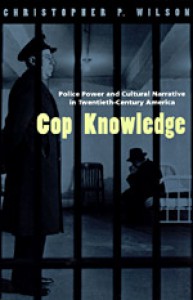
Cop Knowledge
Police Power and Cultural Narrative in Twentieth-Century America


 (0 vote)
Average rating:
| 0 | rating |  = We can do without = We can do without |
| 0 | rating |  = Good book = Good book |
| 0 | rating |  = Excellent book = Excellent book |
| 0 | rating |  = Unique / a reference = Unique / a reference |
Your rating: -
Book Presentation:
Whether they appear in mystery novels or headline news stories, on prime-time TV or the silver screen, few figures have maintained such an extraordinary hold on the American cultural imagination as modern police officers. Why are we so fascinated with the police and their power? What relation do these pervasive media representations bear to the actual history of modern policing?
Christopher P. Wilson explores these questions by examining narratives of police power in crime news, popular fiction, and film, showing how they both reflect and influence the real strategies of law enforcement on the beat, in the squad room, and in urban politics. He takes us from Theodore Roosevelt’s year of reform with the 1890s NYPD to the rise of "community policing," from the classic "police procedural" film The Naked City to the bestselling novels of LAPD veteran Joseph Wambaugh. Wilson concludes by demonstrating the ways in which popular storytelling about police power has been intimately tied to the course of modern liberalism, and to the rising tide of neoconservatism today.
"A thorough, brilliant blend that crosses disciplines."—Choice
"[S]ophisticated, highly theoretical and ambitious. . . . Connects the history of policing to cultural representations of crime, criminals and cops."—Times Literary Supplement
"[A] deeply satisfying approach to the crime narrative. . . . [Wilson] focuses, ultimately, on the role of police power in cultural storytelling."—American Quarterly
> On a related topic:
Crime Fiction and Film in the Southwest (2001)
Bad Boys and Bad Girls in the Badlands
Dir. Steve Glassman and Maurice O'Sullivan
Subject: Sociology
The Cinema of Converging Lives (2025)
Complex Films and Intersecting Stories in an Isolated World
by Lucy Fischer
Subject: Sociology
Alien Identities (1999)
Exploring Differences in Film and Fiction
by Deborah Cartmell, I. Q. Hunter, Heidi Kaye and Imelda Whelehan
Subject: Sociology
Beyond the Stars 4 (1993)
Locales in American Popular Film
Dir. Paul Loukides and Linda K. Fuller
Subject: Sociology
 Back
Back

