


Possessed
Hypnotic Crimes, Corporate Fiction, and the Invention of Cinema

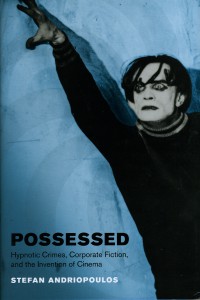

 (0 vote)
Average rating:
| 0 | rating |  = We can do without = We can do without |
| 0 | rating |  = Good book = Good book |
| 0 | rating |  = Excellent book = Excellent book |
| 0 | rating |  = Unique / a reference = Unique / a reference |
Your rating: -
Book Presentation:
Silent cinema and contemporaneous literature explored themes of mesmerism, possession, and the ominous agency of corporate bodies that subsumed individual identities. At the same time, critics accused film itself of exerting a hypnotic influence over spellbound audiences. Stefan Andriopoulos shows that all this anxiety over being governed by an outside force was no marginal oddity, but rather a pervasive concern in the late nineteenth and early twentieth centuries. Tracing this preoccupation through the period’s films—as well as its legal, medical, and literary texts—Andriopoulos pays particular attention to the terrifying notion of murder committed against one’s will. He returns us to a time when medical researchers described the hypnotized subject as a medium who could be compelled to carry out violent crimes, and when films like The Cabinet of Dr. Caligari and Dr. Mabuse, the Gambler famously portrayed the hypnotist’s seemingly unlimited power on the movie screen. Juxtaposing these medicolegal and cinematic scenarios with modernist fiction, Andriopoulos also develops an innovative reading of Kafka’s novels, which center on the merging of human and corporate bodies. Blending theoretical sophistication with scrupulous archival research and insightful film analysis, Possessed adds a new dimension to our understanding of today’s anxieties about the onslaught of visual media and the expanding reach of vast corporations that seem to absorb our own identities.
Press Reviews:
Not only a groundbreaking study of early twentieth-century German film and literature, Stefan Andriopoulos’s Possessed is an extraordinary examination of cultural anxieties about individual agency and autonomy amid the consolidation of corporate and institutional power at the beginning of the previous century. With exemplary historical precision and intellectual nuance, the book illuminates the relations between early cinematic attractions, modernist fiction, and emerging technologies of control and suggestion."—Jonathan Crary, Meyer Schapiro Professor of Modern Art and Theory, Columbia University
Jonathan Crary, Meyer Schapiro Professor of Modern Art and Theory, Columbia University
“Ambitious and wide-ranging, Possessed is a remarkably invigorating interdisciplinary exercise that will be read with profit by individuals in cinema and media studies, comparative literature, and the history of science. It reaches conclusions that are both precisely stated and inordinately suggestive.”--Eric Rentschler, Arthur Kingsley Porter Professor of Germanic Languages and Literatures, Harvard University
Eric Rentschler
“A superb testimony to the enduring allure and resonance of German Expressionist cinema, Possessed illustrates the richness of a methodology that recharges the past with new symbolic energy.”
Anton Kaes, Chancellor Professor of German and Film Studies, University of California, Berkeley
"[The author] provides numerous new insights into early-20th-century German culture while also illuminating some provocative parallels to debates over media and corporate culture in the early 21st century."
Choice
“Stefan Andriopoulos’s fascinating, interdisciplinary study examines in great detail the connections between legal, medical, and literary discourses of hypnotism, and the birth of cinema. His aim . . . is admirably supported by a comprehensive survey of discursive developments in the legal and medical worlds, and how literature, and then cinema, appropriated this discourse in the name of entertainment. . . . Andriopoulos relates how Guy de Maupassant once received a hallucinatory visitation of his own self, which compelled him to write material against his own will and subsequently disappeared again. This anecdote seems to be an appropriate note on which to end an overall compelling account of hypnotism and somnambulism in the early years of German cinema.”
German Quarterly
> On a related topic:
The Invention of the Spectator (2026)
How has Early film Spectatorship shaped Audience and Reception Theory:Selected Writings 1910-1920
Subject: Silent Cinema
A Queer Way of Feeling (2023)
Girl Fans and Personal Archives of Early Hollywood
Subject: Silent Cinema
The Othering of Women in Silent Film (2023)
Cultural, Historical, and Literary Contexts
Subject: Silent Cinema
At the Picture Show (2001)
Small-Town Audiences and the Creation of Movie Fan Culture
Subject: History of Cinema

 Back
Back

