

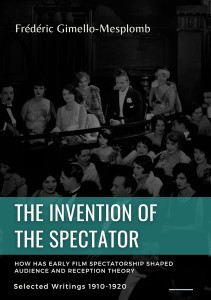
The Invention of the Spectator
How has Early film Spectatorship shaped Audience and Reception Theory:Selected Writings 1910-1920


 (0 vote)
Average rating:
| 0 | rating |  = We can do without = We can do without |
| 0 | rating |  = Good book = Good book |
| 0 | rating |  = Excellent book = Excellent book |
| 0 | rating |  = Unique / a reference = Unique / a reference |
Your rating: -
Book Presentation:
This monograph reconstructs the intellectual genealogy of audience theory, shifting the historiographical focus to the often-overlooked decades preceding the Weimar period (pre-Kracauer). It contests the prevailing academic narrative that reduces pre-1920s cinema inquiries to mere quantitative demographics or moral surveillance. Instead, the text demonstrates that the years 1900-1915 generated a sophisticated, albeit fragmented, body of theoretical work regarding the social and psychological dimensions of moviegoing. Embedded within the structural shifts of industrial modernity, capitalism, and metropolitan growth, the analysis identifies how early scholars conceptualized the cinema as a primary agent of cultural production. The book aggregates disparate sources from psychology, sociology, and urban studies to reveal a coherent discourse on spectatorship. It argues that these initial observers identified the audience not as a passive mass, but as a collective engaged in active cultural negotiation and psychological processing. By retrieving these archival sources, Frédéric Gimello-Mesplomb maps the transition from initial curiosity to systematic academic inquiry. It provides a detailed account of how the "moving picture" was understood as a vector for social interaction and consciousness formation long before the canonization of classical film theory. This study offers a revised timeline for the discipline, locating the origins of reception studies in the immediate friction between early audiences and the screen.
About the Author:
Frédéric Gimello-Mesplomb is Professor of Media & Cultural Studies at the University of Avignon, France and researcher in the Audiovisuel Research Lab at the University of Toulouse - Jean Jaurès. A former Visiting Scholar at the University of California, Berkeley, and former faculty member of the Academy of Television Arts & Sciences (Emmy Awards) in Hollywood, he brings an international perspective to his research on media economics, and film policy. He is the author of numerous scholarly works on French cinema, French Cultural policy and Film Music.
> On a related topic:
A Queer Way of Feeling (2023)
Girl Fans and Personal Archives of Early Hollywood
Subject: Silent Cinema
The Othering of Women in Silent Film (2023)
Cultural, Historical, and Literary Contexts
Subject: Silent Cinema
Possessed (2008)
Hypnotic Crimes, Corporate Fiction, and the Invention of Cinema
Subject: Silent Cinema
At the Picture Show (2001)
Small-Town Audiences and the Creation of Movie Fan Culture
Subject: History of Cinema
How the Movies Got a Past (2023)
A Historiography of American Cinema, 1894-1930
Subject: Silent Cinema
 Back
Back

